
Monday, December 26, 2005

memoirs of inauthenticity

Before seeing Memoirs of a Geisha I thought my objection would be the de-Japanification of that exactly most specifically Japanese of all topics--geisha, for the sake of commercial viability. I was wrong, that is only one of my objections.

The movie plods oh how it plods. The Chinese actresses who play the three main characters do their best but have been cast only with an eye to box-office appeal. They are all better draws even in Japan than any Japanese actress. Though fabulous, especially Gong Li as "Hatsumomo", they don't look Japanese, or convey geisha or Japanese-ness. They can't. It's not simply a matter of acting. Is this a quibble?

There is the language problem. Dubbing and subtitles are box-office poison of course but this alternative, in which everyone speaks English in a slightly British, over-deliberate halting manner, abstracts the characters right out of their setting. Japan without the Japanese language misses most of the point of the place.

The conceit is that you are equipped with a universal translator, or that it's just a really good dubbing job. This conceit breaks down if you introduce actual English speakers into the movie which they do. When the Yanks arrive Sayuri speaks English to one of them (hey, it's Stottlemyer from Monk!) without missing a beat. Huh? Michelle Yeoh speaks beautiful real English to Ziyi Zhang who is obviously just speaking English phonetically.

I used to watch Sumo on NHK TV. You could hear the commentary in Japanese or in English. Even though I couldn't follow all of the Japanese commentary, I couldn't bear to listen to the American announcers. It was excruciating, because a Japanese art, minus its native language, becomes a travesty. The language is woven into the art.

People wonder why Americans can't tell the difference among Asians. We often just use the term "Chinese". But Asians here will mix it up if there's a buck to be had in the blurring of the lines. Chinese restaurants serve cheap sushi and sake at their luncheon buffets. Few of the knife-twirling cooks at Bisuteki are Japanese, but they pretend they are. We are none the wiser. Who cares, a bit of non-threatening faux-exoticism is enough for us. Beyond that and whoa, easy on the details, Poindexter-san!

This would all matter less if the story itself were not so leaden. Eight-year-old Chiyo falls in love with the "Chairman" after a five-minute exchange? How old is a Chairman? It is absurd. Fifteen or whatever years later, after surviving the war, she is now in her mid-twenties, so he is now what, sixty? Chiyo has grown into the adult Sayuri, while Ken Watanabe looks as if he has aged about a month. An apparent 30-year age difference is reduced to a more palatable say, fifteen-year difference at the end, but if you do the arithmetic, the result is preposterous not to mention creepy. Will she be happy for long, spoon-feeding him his tofu in his dotage?

Hatsumomo and Sayuri get into a fight and start a fire in the okiya. Hatsumomo further lights the joint up by spilling oil lamps, and...nothing? The whole neighborhood would have burned down. What happened?

The deprivations of war changed everything, forever, says the narrator. World War II is a picturesque distraction consisting of a couple of trucks rolling through "Gion" or Thousand Oaks, CA, and a shot of planes overhead. These years pass in a minute. Then we see Michelle Yeoh again, expecting her to have aged terribly. But she too seems to be little the worse for wear, having also aged about a month. Her deprivation seems to consist of changing to a modest gray kimono and leaving her hair untended for a day or so.

Bah! Too bad. Compare this turgid plod to Kar Wai Wong's hallucinogenic 2046 also starring Gong Li and Ziyi Zhang, and the House of Flying Daggers, to see what Zhang is capable of. And of course, Crouching Tiger, Hidden Dragon to see Zhang and Yeoh fly.

My favorite Asia-through-the-eyes-of-clueless-Americans movie is Green Berets made in 1968. Starring John Wayne, and featuring such local talent as Jack Soo (Det. Yemana from Barney Miller), and George (Mr. Sulu) Takei playing South Vietnamese Army officers. Wayne, Aldo Ray and a crew of paunchy, freshly shaved and scrubbed middle-aged farts lumbering around Georgia among the arid pine forests playing soldier in the jungle. The pine jungle. It looks about as much like Southeast Asia as Norway.


Thursday, December 22, 2005

before you begin--oops, too late!

This summary is not available. Please click here to view the post.

Tuesday, December 20, 2005

bartleby otsuka pynchon RAQ

Bartleby the Scrivener is a short novel by Herman Melville written in 1853, about an office clerk famously known for his refusal to do work by repeating the phrase, "I would prefer not to." Blog commenter Bartleby has twice now expressed curiosity about how certain entries in this blog relate to certain lyrics found in Japanese pop music.

The first comment to "Brother Linus channels the SubGenius", posted on 11/01/05:
Interesting. Can you explain the significance of the lyrics "Koi suru onna no ko no Victory" by Morning Musume?

The second comment to "A is not Q's patsy", posted 12/20/05:
But how does this relate to Otsuka Ai when she chimes "waratte waratte kimi to ashita aitai" ? Could it be related to the crying of lot 49?

I will address the second comment first due to a mood of LIFO-ness.

The line is the chorus from Otsuka's single "Smily", which has sold more than 300,000 copies:
"smile smile, I want to see you tomorrow"

Otsuka Ai or Ai Otsuka when she's filling out her US visa app, is a highly-popular, 23-year-old typical 95-lb super-cute ("kawaii") J pop singer. "Kawaii-sugi" (too cute by half) if you are as sick of "kawaii" as I am. But that's the mold. She'll be a beautiful woman someday if she ever grows up. She has that thin nasal voice demanded of the genre, but plays the piano and writes her own lyrics at least. The Smily video is online. There's even a Smily ringtone!

The Crying of Lot 49 is of course the trippy convoluted '60s Thomas Pynchon novel, assigned to me in senior-year English class at St. Newt's Prep. (How did Bartleby know this?) Like most books assigned at school, I never got through it, but remember its later fame for being among other things the source of several references in the '84 movie The Adventures of Buckeroo Banzai Across the 8th Dimension ("no matter where you go, there you are"). Mostly notably perhaps, the Yoyodyne corporation, workplace of the Red Lectroids. The protagonist in Lot 49 was Oedipa Maas, a young woman (like Otsuka--hmm...) who inherits her boyfriend's estate when he dies. Lot 49 was an auction lot containing her boyfriend's stamp collection. "Crying" a lot is what they call the bidding at an auction.

But this is all preliminary. A complete explanation of the relation between Q is not A's Patsy, Otsuka Ai's Smily lyric, and The Crying of Lot 49 will require months of further research. Until that time you may amuse yourself by looking at my old Tokyo home, which I shared with a certain Chris Bartleby among many others, and which could have fit into a Pynchon novel, no problemo.

Sunday, December 18, 2005

A is not Q's patsy

(In which A responds to perceived bullying by Q and rejects one of Q's criticisms of the FAQ.)

A. I don't answer to you, you pompous windbag.
Q. How dare you?

A. Your questions serve only to advance your narrow agenda, not to provide illumination.
Q. You presume to lecture me?

A. Indeed it is in the answer that the knowledge lies, not in the question.
Q. Are you questioning our arrangement?

A. The question is subordinate--merely the path to the answer. The answer is the destination, the goal.
Q. Do you seek to undermine my authority?

A. The phrase "asked question" is not necessarily redundant.
Q. But did I not force you to agree, that unless a question is asked, it cannot exist?

A. A statement is only truly redundant if it is redundant from every possible perspective.
Q. What are you talking about?

A. Though a question must be asked to exist, it is also valid to consider, for example, how often the same question is asked. One question may be asked rarely ("Where are the Crispins of yesteryear?"), while another may be asked frequently ("Where did I leave my goddam keys this time?").
Q. What is your point?

A. Distinguishing between questions that many people ask, and questions that few people ask, and answering the former, is not only an efficient means of conveying information, it is also a non-redundant perspective on the phrase "asked question".
Q. Can you run that by me again?

A. Unless the phrase is redundant from every possible perspective, the phrase is not redundant. I have provided a non-redundant perspective of this phrase, therefore the phrase is not redundant.
Q. Do you think anyone will listen to you?

A. Indeed "asking" a question, is the most common thing people do with questions. In fact, since someone must ask the question for it to come into being, it is not only not redundant, but necessary.
Q. Surely you don't think you can get away with this, do you? How will people pronounce FQA?

A. To ask the question is the most common way to convey it. For example, you ask "Where are my keys?", and you can ask the question "Where are my keys?" (Redundant, or not? you be the judge!), but you cannot just question "Where are my keys?".
Q. What about posing a question? Pondering, bringing up?

A. Yes, and you can "question" authority. But authority is not a question. I need only demonstrate that "asked question" is not redundant from every perspective. My work here is done.
Q. Wait, don't go. I'm not done! Don't you want to hear my next question?

A. In conclusion, unlike your questions about the redundancy of the phrase "asked question", your questions about the hypocrisy of the FAQ writer just making up questions with no idea of their actual frequency, showed promise. Perhaps some day you will ask questions (!) worthy of my answers.
Q. Can we meet again?

Saturday, December 17, 2005

CL smites the defilers

The Catholic League is shocked (shocked!) at the defilement in the South Park episode "Bloody Mary", described in control my life, please.

In a news release, they request of the nearest available Catholic, Joseph Califano who is on the board of directors of the company (Viacom) that owns the company (MTV) that owns Comedy Central, that he intervene to get an apology to Roman Catholics and a pledge that this episode be permanently retired, and not made available on DVD. Failing that they ask that Califano issue his own statement of condemnation.

Take that, Butters! But if the Queen Spider couldn't stop Red Hot Catholic Love from getting on DVD (season six--in stores now!), probably Califano won't be able to stop Bloody Mary, either.

And not a word about the point of the show which was the ease with which we give up our self-determination in favor of relying on whatever hint of a greater power happens along, no matter how ludicrous.

Oh that's right, encouraging the worship of Mary's face in a window stain or a bagel is the business they're in.

Thursday, December 15, 2005

the why FAQs suck FAQ

Q. Isn't the act of asking a question, what makes a question be a question?
A. Yes. It is the asking that brings the question into being.

Q. Can an unasked question exist?
A. No! For it is in the asking, that the question comes to be. Left unasked, it does not exist.

Q. Isn't, then, the phrase "asked question" not only redundant, but downright stupid?
A. Yes.

Q. There would be no point, then, in creating a FUQ, for frequently unasked questions?
A. As a Zen koan, perhaps. And it would be more fun to say than "fack". But though an amusing concept, such a list would be impossible to create due to the metaphysical contradiction alluded to in the earlier questions.

Q. Would not "FQ", meaning "frequent questions", be a better term?
A. The purpose of the A in FAQ is to provide pronounceability of the acronym. "fack", though a hideous word which sounds like you are ejecting a hairball from the throat, is easy to say. "FQ" is too much trouble to say. Redundancy and stupidity is the price we pay for this convenience.

Q. "Frequently asked" implies some mechanism for sending questions to you, the FAQ owner, such that you can tally them up and answer the ones you receive most often. Is there such a mechanism?
A. No. The implication is deceitful.

Q. How then, do you know what questions are frequently asked? Or even asked at all?
A. One question at a time please. The answer to both is the same. I do not know.

Q. Are you just making up what you imagine people might ask, because you have no way of actually knowing what they might ask?
A. Yes it is true. I make the questions up because I have no way of actually knowing.

Q. Are you aware that the practice of providing a FAQ with a new product is inherently dishonest, because a new product has not been available to those who might ask questions about it long enough to count up the questions to determine their frequency?
A. Boy you got me on that one.

Q. How do you live with this hypocrisy?
A. It is a source of unending shame.

Q. In fact is not a developer the worst person to come up with the questions in a FAQ, because that person knows the product too intimately to put themselves in the position of the very person who needs the FAQ the most, a person who has just come to the product knowing nothing, who looks to the FAQ for informational sustenance?
A. I am forced to admit that you are correct.

Q. Is a FAQ just a lazy way of writing your documentation, because it's too much trouble to organize the information logically, by topic?
A. Yes, it is true.

Q. Is the real reason you have a FAQ, in spite of in your heart knowing it is deceitful and lazy, that you think people expect you to have one, because everybody else does?
A. Yes my friend. You have revealed the truth.

Q. Are you aware of the fallacy known as ad populum or "appeal to popularity", which states that because most lemmings approve of a claim (in this case, that a FAQ is necessary or good), that the claim is therefore true?
A. Yes. At one time most lemmings thought the world was flat. But that did not make it so.

Q. Do you resolve then to get out of the FAQ-writing business, and pledge yourself to righting this wrong by being honest with your readers?
A. I so resolve. Henceforth I pledge to write either proper topic-based documents, or provide the less pronounceable but more truthful QIGPMABIFHNFIITW--Questions I Guess People Might Ask But In Fact Have No Fucking Idea If They Will.

Q. When encountering a new object, what do you suppose is the most frequent first question about the object?
A. What is it?

Q. What is GlassFish?
A. I don't know. The question is insufficiently frequent to be addressed by a FAQ.

the GlassFish breathmint floorwax dilemma

After a couple of months I have begun to dip my handsome new toe back into Java. It's a world where words mean anything--how I missed it!

"GlassFish", for example. What is it, exactly? Go to the GlassFish page and figure it out.

First, the page header is "GlassFish Community" but you are in the Projects tab, not the Communities tab. You might think, naive you, that they would explain what it is, not who they are. (A rude secret: I do not give a shit who they are--I only want to know what it is!) They are a community! But it looks like a project--there's a button on the left after all, that says GlassFish Project Home. Maybe it'll say what it is there! Click on it and surprise, it goes back to the page you're already on, the community page! So I guess it's a project, about a community, that is building a server.

Maybe the FAQ will explain what it is. Hmm the first question is not what is it, which would seem to me to be frequent question Number One, but rather, where can I get it. [12/17/05 Since modified! Now they say, What is Project GlassFish? first--still not What is GlassFish, but closer.] No worries, I see on the FAQ, a "New to GlassFish" link. I'm new--I want to know what it is. Follow this link and hmm...this link says it's a project, after all. I can introduce myself to others participating in the GlassFish project, I can become a part of it, I can even request a feature!

The GlassFish project provides a structured process...

So, I know that its community is building a server, and its project is providing a process. I just don't know what it is.

Let me click on the Communities tab at the top, to get my bearings. To see a list. At right is the list of communities but what's this--GlassFish is not listed! Ack where the hell am I? Thank goodness for the Back button.

Of course, I am being coy with you! I know what it is--it's an application server. They re-use the name of the community, and the project, for the actual thing. And not just any server, but an "Open Source Java EE 5 Application server". Which I installed. At least I think I did. When I run the server, the title is:

Sun Java System Application Server Platform Edition 9.0

Uh...did I do it right? Do they have enough goddam nouns in there? Sun is the noun string champion. "Platform Edition"--what's that? Is it like the "Platinum Edition"? Is this in fact "GlassFish"? If so why doesn't it say so? Otherwise why did they bother to call it GlassFish in the first place? Where's the little fish logo? And on the bottom of the Welcome page is a link to Project GlassFish "Sun's open source application server", with no acknowledgement that this is that server! Isn't it?

Oh how I remember now, why I fled screaming from these semantic tanglers. Where Apache is a software foundation, a project, and a web server and it's up to you to figure out which one they're talking about at any given moment. How about "Apache Tomcat"! It's why so many people think Tomcat "runs on" Apache. Why isn't it "Jakarta Tomcat"--it wouldn't be confusing enough?

How can such brilliant people be so lousy at explaining themselves? Why are they so willing to attach the name to the community and the project, and so timid about attaching the name to the only thing that actually matters. Come on then, out with it. It's: the GlassFish Application Server! And put the name in the product! If GlassFish is not its name, then don't call it that in the install, and toss it on the dustheap of useless terms like "Jakarta".

Here is my suggestion. The most important information to convey about a thing is, what is it. Not who are the nice people in the community that builds it, and not that the project provides the nice process that helps you build it. But, WHAT IS IT. Say that first.

Wednesday, December 14, 2005

toe job

Upon deciding to "retire" I quickly contacted an orthopedist in Brookline (reminiscent of J'aurais voulu avoir un marchand d'épingles a cheveux en Belgique--I would like to contact a hairpin salesman in Belgium) to whack off that cause of much pedestrian grief, the excess bone at the base of the right big toe, that looked like a bunion but was not. Known as a "dorsal" bunion because it looks in X-ray like the dorsal fin of a fish, it is not in fact a bunion at all but rather a bone spur, a byproduct of hallux rigidus which is Latin for "stiff toe". Latin can make anything sound impressive.

So it is a faux bunion. Change the first and last letters and you get a Paul Bunion. (Ya I know, he was a Bunyan.)

The deed was done as an outpatient, at a remarkably efficient orthopedic clinic/factory (saws buzzing, knees, feet and elbows flying every which way), on Sept 13, using local anaesthesia. I was able to recuperate on the company nickel with a few days off, followed by a few days of "working" at home.

The picture at left was the unveiling two weeks later.

The surgery fell into a gray area--not cosmetic, but strictly speaking not necessary either. "Elective"--the sort of thing you could live without, if you don't mind wearing sneakers for the rest of your life. How about showing up for that job interview in sneakers! Well Mr Keefe we would have offered you the job but your footwear, I'm afraid, does not meet the high standards we set here at Bratwurst, Longjohnson and Feen... However it is cosmetic in the sense that it does not repair the underlying ailment, which is arthritis of the joint, and of which ze bump is but a mere symptom.

I had had the left one done two years earlier, by a different hairpin salesman. The most famous victim of this ailment is Shaquille O'Neal.

Now a mere 90 days later, I hobble carefree again! Well not quite. The joint still hurts when wearing shoes or standing en pointe in my tutu, but tant pis, more motion is gained, and I was sick of looking at it anyway. And if not then, never. Complete benefit of the surgery takes six months. I got some Percocets out of the deal at least and the urge, for some reason, to toss high-school French about.

Meanwhile other arthritis advances. Gains a toehold. The neck is going a bit stiff when turning to the right, a condition most obvious when backing up the car. Soon I will be one of those old coots who backs up using the rearview mirror instead of turning around to look.

Attention, un vieil imbécile conduit!

Monday, December 12, 2005

control my life, please

In the South Park episode "Bloody Mary", the sensei lectures Stan's karate class about "serf-disciprine". His dad Randy then gets pulled over for drunk driving while giving the kids a ride home. His sentence includes attending AA meetings, where he is forced to engage in the twelve-step program. Step One is to admit that he has no control over his alcoholism, because it is a "disease".

Since he has no control, he confines himself to a wheelchair, continues to drink, and waits for the only possible cure, divine intervention. He is finally "cured" by visiting a statue of Mary that is miraculously shooting blood out of its ass. It is then revealed that the statue is not really miraculous (!) and that therefore Randy must have, albeit unwittingly, cured himself. Stan suggests to his dad that this is perhaps an indication that the cure for overcoming a personal weakness is to be found within oneself, by means of "serf-disciprine".

Funny, I have the same objection to AA. Step One: admit that you have a "disease", so are powerless and must rely on God to cure you.

My brother went to AA meetings for ten years till he drank himself to death at the age of 39. But, AA was and often is the only game in town. What about alternatives? How about Rational Recovery?

My mother went to a few Al-Anon meetings, for the relatives of alcoholics, but she did not gain comfort from listening to more of the travails of families with drunkards. She needed less, not more exposure to the problem--perhaps "Al-Anot"--meetings of people whose relatives were not alcoholics. If such people exist.

The closest I've come was attendance at satsangs or devotional meetings, for the followers of the Guru Maharaj Ji who was quite big in the 70s. Once at UMass on a lark, and again when I lived in Sydney. A neighbor, relatively sane for a cultist, was a devotee who, tired of my ridicule said that I shouldn't poke fun unless I saw for myself, which, after taking steps to assure that I would not be murdered and sacrificed to the guru, I did.

Devotees took turns rambling on with the familiar tale of redemption--how they were lost, helpless on their own (sound familiar?) until they found AA I mean the Maharaj Ji, and how he had changed their lives since.

Later back in the US my housemate's brother moved in with us, and satsanged about the Maharaj Ji over the phone for hours each night, because he couldn't reach the meetings because he didn't have a car because he couldn't afford one because he couldn't hold down a job because he was out of his fucking mind. He was also a rare male anorexic, who ate according to the dictates of Arnold Ehret's Mucusless Diet Healing System, until he died.

Alcohol, Maharaj Ji, Jesus, the Pope, the will of Allah, mucus avoidance...is there no end?

Relinquishing our self-determination to whatever "greater" power happens along during a time of weakness, is humanity's most compelling urge....

Saturday, December 10, 2005

sunk cost

Barry Schwartz, in The Paradox of Choice (which I finished so can cross off my list), talks about "sunk costs". He mentions those expensive shoes you bought that are sitting in the back of the closet. You keep them even though you know you're never going to wear them again, because to get rid of them would force you to acknowledge a loss.

Similarly, people hold on to stocks that have decreased in value because selling them would turn the investment from a potential loss into an actual loss.

What should matter says Schwartz, are the prospects of future performance, but what seems to actually matter is the level of previous investment. He believes that "sunk-cost effects are motivated by the desire to avoid regret rather than just the desire to avoid a loss". "Regret avoidance" is a stronger demotivator than simple "loss avoidance" because taking the corrective action forces you to acknowledge the source of the regret, which is your personal responsibility for an initial decision which has turned out to be flawed.

His final example is Vietnam, and is apropos of the suddenly-legitimate argument, thanks to Jack Murtha, that we should get out of Iraq quickly:


And arguably, why did the United States persist as long as it did in Vietnam, even when it was plain to virtually everyone involved that no good outcome could result from continued involvement? "If we get out now," people said, "then all the thousands of soldiers and civilians who have died will have died in vain." This is thinking in terms of the past, not the future. Those who had died were dead and could not be brought back. The questions that should have been asked (all moral and political considerations about the appropriateness of the war aside) concerned the prospects of soldiers and civilians who were still alive.


Maybe we should leave Iraq soon, or maybe we should remain "as long as it takes". But the reasons to stay should not include that otherwise those who died did so in vain. Or that leaving would force us, or more specifically the President, to acknowledge and therefore take responsibility for, the error of the initial decision.

These are powerful, but not valid, reasons to remain in Iraq. They represent the fallacy of the sunk cost.

Friday, December 09, 2005

purity of essence, webcam division

The Globe having published a cool article about how to build a better webcam, I followed the procedure at Dennison Bertram's site.

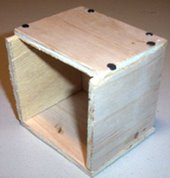
Simple! Just build a 3"-square box. Well, not so easy for the slovenly woodworker. The first attempt, done in a cavalier manner with power tools was charming in its primitiveness, but unsuitable for mounting a lens. You cannot or at least I cannot cut square 3" pieces of wood only 1/4" thick with a table saw or circular saw--an exercise similar to whittling toothpicks with a chain saw.

After gouging the iron patio table twice, and the aluminum top of the table saw once, with the blade of the errant circular saw, I finally took a look at the blade--oh my. Really ought to change it every ten years or so, or after every second attempt to drive it through an iron table. The blade of the table saw was likewise missing a few teeth and sporting a fine coat of rust. Maybe from that summer it sat outside...

Attaching the metal ring from the old camera onto this flimsy wood was a challenge. The ring has holes for screws which must be small enough to lie flush, otherwise the lens won't screw on, but have enough bite to hold the ring tight in the soft wood, to withstand the sideways pressure of twisting the lens in.

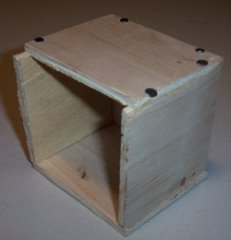
The whole lot was held together, barely, with carpet tacks. The pieces were off-kilter at every angle possible. The spot at the bottom is blood from a stuck thumb.

This travesty led to a realization. I had visions of Zen and the Art of making a 3" Webcam Box but when it came to actually doing the work, realized that I am a slacker content to do a lousy job.

This haphazard little pile of sticks had turned into a metaphor for my haphazard approach to life. Leading to a visit to the garage in search of better tools and more important, purity of essence. And to the library to read up on woodworking. Where I learned things like using separate blades depending on what you're cutting, keeping your power tools out of the rain, and wearing safety glasses. Boy those guys are so fussy! But they have purity of essence by the bucketful, with their hours of fastidious blade sharpening, jig assembling, and fine, ever so fine, cabinet making. They had so much purity of essence they kept extra stored carefully in cool dry places, more than I could ever hope for.

My tools on the other hand were lying about neglected, covered in years of rust and grime. Like my personal finances, my clothes, my books, my hair, my garden, my fishtanks, my computer programs. All in some manner of mess--in piles, dirty, or held together with carpet tacks. Zen and the Art of Being a Fucking Slob--that was my book.


The second attempt, which began with a week of garage cleaning, then tool cleaning, fared better. It included a satisfying contemplative three-hour stint sorting a mountain of random bolts, screws, washers, nails, twigs etc, aided by the powers of concentration afforded by two Percocets.

V2 was built with hand tools and glued together. No tacks. And included long machine screws in back to set the focal point of the CCD chip to the correct length from the lens. The result is mechanically solid but has a focal point too distant for my purpose (hah--as if there was a purpose to any of this)--it can read sheet music 20 feet away, but I want a wider view and greater depth of field. No matter--for now the carpentry is under control at least, and I can swap lenses out, if I ever get another lens. My plan now is for this to be deployed out the back garage window, pointing to the neighbor's birdfeeder. A purpose if not exactly Zenlike, at least frivolous.

Pieces of the original box were then redeployed to a structure more appropriate to my skill level, "Casa Bella", which thus far Bella refuses to enter, but enjoys chewing at least. We'll see what kills him first--the acrylic paint, or one of the cats. When he dies the wood can be redeployed yet again, as a parrot coffin.

(Tip o' the pin to to Gen. Jack Ripper of Dr. Strangelove, for "purity of essence".)

Thursday, December 08, 2005

network this

Fresh from a two-day "How to get a job" class at Root, Foonweather and Lemming (ROFL). I am not looking for a job now, but the class is a benefit that expires, and I'll be looking for a job eventually, when the kids get a little more gaunt and we run out of furniture to burn to stay warm.

Casual assertions mixed with false specificity brought corporate Powerpoint presentations to mind:

  • 64% of jobs are gotten through "networking"
  • 80% of people don't like their jobs
  • 25% of your job is what you are actually good at or like
  • the chances of getting a job via the "internet" is 16% or 4%, depending on the day of the seminar, and is greater if you are "technical"

It is apparently insufficiently authoritative to say that "many", or even "most" jobs are gotten through people you know as opposed to "cold" contacts--it has to be backed up by a "statistic"--64%. Whose specificity (not 61%, or 66%), and presentation as a pie chart, implies that quantifiable data is available to prove the point. When in fact 64% is simply shorthand for "many", or "most". The problem with saying "many" or "most" is that the statement is then self-evident. Of course most jobs are gotten through people you know! Thus the old definition of sociology as the science of belaboring the obvious.

The term "networking" is bloviation--so nebulous as to be useless. As evidence of its value we are asked in turn how we got our current jobs and sure enough, for the most part we got them through somebody we knew. But hearing about a job by chance, a common occurrence 20-30 years ago during various hiring booms, and actively hunting down leads now in a diminished job market through your various contacts, are quite different activities, and should not both be called "networking". The former (hey they're looking for people with a pulse at DEC!) should not be used to pad the "statistic" of the likelihood of success of the latter.

And the question is posed, if 64% of jobs are gotten by networking, and only 36% are gotten by other means such as the "internet" or cold calling, why do people spend a disproportionate amount of time pursuing these unlikely means, rather than on networking?

The "pie chart of shame":

To which we answer, slightly ashamed at having been exposed foolishly looking for jobs in the wrong place duh, we don't know...but the question is an assertion we didn't agree to in the first place. Who says people spend more time doing cold calls or looking on the internet, than "networking"? Where did you get this statistic?

When, at the risk of seeming to be a churl or an ingrate, you challenge the premise behind these assertions the response, in a patronizing manner, is well for you technical types, we realize that the whole thing is more an art than a science, and that these numbers are just to "give you an idea". As if you were a geek wearing a Star Trek uniform and rubber Spock ears shouting in an adenoidal whine, "statistical anomaly! statistical anomaly!"

A company such as ROFL whose business is coaching the art of the job search must for credibility's sake appear to be scientific in its approach. Just don't look too closely.

This is not to say that you should not pursue leads through the people you know. This is to say that it is obvious, and that we should stop using the term "networking" to describe this self-evident activity.

Monday, December 05, 2005

the other dirty weed


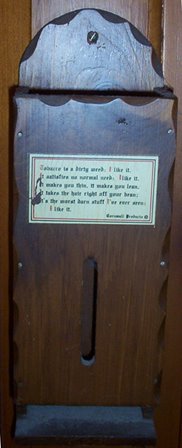
This is a 10 cigarette-pack dispenser--a carton's worth. It is a relic of the 1940s and maybe older. It's on the wall next to the laundry room in the basement. Attached is this bit of doggerel, quite popular in its time:

Tobacco is a dirty weed: I like it.
It satisfies no normal need: I like it.
It makes you thin. It makes you lean.
It takes the hair right off your bean:
It's the worst darn stuff I've ever seen:
I like it.

-Cornwall Industries

It looks like a coffin standing on end. Maybe that's part of the joke.

Though the folks at Cornwall Industries didn't see fit to provide attribution, it was written by Graham Lee Hemminger in 1915 for his campus humor magazine, when he was 20. It was widely reprinted.

This insouciant attitude is rare now--we live longer than ever before, but are nervous health nellies. Living forever is serious business--no jokes allowed. A hundred years ago, if you lived long enough that it was tobacco that killed you, that wasn't too bad.

Aunt Ella, a heavy smoker, got cancer of the jaw in 1961 but after they removed one side of her jaw (I'll never forget the "unveiling" afterwards), lived another 30 years and eventually died of just being ancient. Aunt Betty who did not smoke but lived in the same smoke-filled house got cancer of the tongue but died of being old and fat (I believe the medical term is "diabetes"). Uncle Walter smoked cigars and died of heart failure. My father didn't smoke but drank too much and died of colon cancer.

Hemminger lived to the ripe old age of 55.


Friday, November 18, 2005

precious instruments

Visiting friends in Grenoble a few years ago, I asked if I could send email. Oh yes replied Christian, right this way! He opened the door to a room in their small apartment reserved for the computer. The system was covered in a big white sheet. He removed the sheet, powered the computer and monitor on, and we waited while it booted. Once booted he got his daughter to log in. Finally I could open a browser and use email.

When I was done Christian shut the computer down, turned off the monitor, covered the system with the sheet, and closed the door to the room. They went through this procedure every time they used the computer. The idea of leaving the computer on all the time was preposterous to Christian. The computer was a precious instrument.

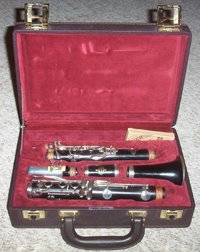
Recently I started clarinet lessons again. I had taken lessons briefly as a boy, inspired by the playing of Larry Fine of the Three Stooges. It didn't last--I didn't like my teacher Jimmy Mosher who though a great musician was no Larry Fine. Teaching nine-year-olds was beneath him.

I bought a clarinet several years ago in the hopes that one of my kids would pick it up. One was playing alto sax so eh, it could happen! I got the other kid to go to a few lessons. She picked it up quickly since she could read music and seemed to have a knack, but was not interested. She said if you're so interested, why don't you do it.

Once in a while I'd assemble the clarinet and give it a try. I treated it the way Christian treated the computer, and the way my aunts treated their living room. Precious!

Every time I felt like playing I'd take it out of the case, assemble it, play for five minutes, then disassemble it and put it back into the case. Which was too much of a bother to do very often.

When I somehow realized I could just leave it assembled and on its stand, and it only needed to be taken apart to transport and for cleaning, the ridiculousness of the "precious" approach immediately became obvious. What was I thinking? Who knew--I thought that's what you did!

Now when I happen to walk by it's there, beckoning--Neil, spiel es noch amol! Maybe in a few years I can achieve Larry Fine-ness or even, my hands are trembling--Naftule Brandwein. Der Yid in Lynn!

Thursday, November 03, 2005

turtles all the way down

The novice asks the master, "Oh wise one, what keeps the world from falling into the abyss?"

The master replies, "The world is supported on the back of a giant turtle."

"But what supports the giant turtle, master?"
"Another turtle, my child."
"And beneath him?"
"Sorry, it's turtles, all the way down."

Begging the question is a phrase I heard more often than I understood. That's what this is.

Intelligent design similarly relies on an infinite stack of turtles. If a structure is (seemingly) too complex to have evolved by natural selection, it must therefore have been designed by an entity that is in turn too complex to have evolved by natural selection. And who designed this entity?

Sorry, it's intelligent designers, all the way down.

(With thanks to Crawford Washington.)

Monday, October 31, 2005

Brother Linus channels the SubGenius

I did so poorly as a freshman at St. Newt's Prep that they thought something was wrong with me. As a result of my entrance exam score I was put in the second highest "Official Class", OC 1 . The classes ranged from OC 0, the "vegetables" who were mostly geniuses imported from New York--and which contained a couple of Jews, the first I had ever seen, and even two black kids, to OC 6, the "zoo", whose kids got into the school because their fathers were alums, or because they were useful football team gruntage.

Something was wrong that's for sure. They expected students to study three hours a night. What? I'm only 13! Half an hour a night, maybe. I just didn't have the metabolism for it. What is the urgency? (Since become a lifelong refrain.) Why are we racing through the curriculum? Let's take a break. Can we go over that again?

The boys of OC 1 were bright and aggressive little snots, used to being smarter than most. I fell behind in all subjects almost immediately, most perilously in Algebra and French which were difficult, and Religion which, I'm saying to myself, are you kidding with this stuff! Didn't we do enough already with the nuns?

Poor performance by a student reflected poorly on the selection criteria. The task of determining the cause of my floundering fell to Brother Linus. Beloved by all right-thinking students, he taught freshman Religion (I was in his class), coached the hockey team and was a guidance counselor. There was no escaping this guy and of course as a loser, I couldn't stand him nor he me.

One of the few things I got right on a Religion test (the very idea is appalling) was a matching question--A. Spilled his seed. Q. Onan. Thus "onanism" which was one of the few fields of study I was motivated to apply myself to for the recommended time. Beyond that I just couldn't manage my Bible facts whose study struck me as a mental exercise similar to and slightly less satisfying than counting the number of holes in each ceiling tile in the classroom.

Oddly enough I had no trouble memorizing years of Catechism back at St Pius's. Apparently I had achieved sentience in the meantime.

So beloved Brother Linus in his role as guidance counselor called me into his office, in an effort to understand this gawky dork of a kid who wouldn't learn his Bible facts, who had pimples and thick glasses and probably wasn't interested in sports. In short, not made of the right Catholic boy stuff.

Nevertheless he puffed on a pipe whose sweet aroma he probably thought was soothing to the troubled lads. Put them at their ease, so they would open up, such that he might get a peek into their... paltry little psyches. Oh Brother, let me reveal myself unto you!

Brother Linus leaned back in his chair, drew on his pretentious utensil of comfort and, inadvertently channeling the not-yet-existent Bob the SubGenius, fixed me with his best patronizing and wise look and asked,

"Well Mr. Keefe, is there anything troubling you--anything on your mind?"

Though not yet able to articulate for this beloved Brother the SubGenius doctrine of Slack, I was not too young for self analysis, and was aware enough of the sources of my misery. But I wasn't about to tell him, being part of the problem, after all! Smug Catholic prick, secure in his musky status quo, surrounded by his well-adjusted boy soldiers, who gave the likes of him their unquestioning loyalty, in return for a secure place in the Papist army.

Was that Old Spice I smelled, beneath the Cherry Blend tobacco?

The little atheist-to-be can not but squirm under the brutal thumb of his Inquisitor and after leaving his office squirm still more under the brutal thumbs of his young minions!

Another Brother gave me an IQ test, to be sure they hadn't made a horrible mistake. He asked me the population of the US and I said 200 million, which was pretty good for '67 I think. I also knew the capital of Bananistan, and that Bolivia exported tin, but he didn't ask about them. He did ask if I knew what audacious meant and I said it means chutzpah. I didn't mean to be a wisenheimer in that particular case, but couldn't think of any other word and anyway he ought to know from Mad magazine.

So at the end of freshman year my parents received a nice handwritten letter, in wobbly fountain penmanship, from Headmaster Brother Ricardo informing them of my fate. Expelled! Such is the lot of the Catholic shmendrik. Darn the luck. But wait!

My mother wrote back and said that her son had been unable to concentrate due to his distress over her medical condition. I had no idea she had a medical condition and probably wouldn't have noticed if she did. Anyway she didn't have one--she was fine. She had gone into the hospital briefly for a hysterectomy, described to me by my aunts as "a women's plumbing problem"--uck, that was as much detail as I wanted to know, and I never gave it a moment's thought.

Being wise in the ways of the One True Holy Catholic and Apostolic Church she also enclosed a check, and after a few weeks in Lynn summer school doing long division and typing with the other retards, I was back the next fall, in OC 3 whose kids weren't quite as smart and with whom I could keep up, with my customary study habits.

Years later I learned that beloved Brother Linus died from falling down a flight of stairs at the school. I didn't feel glad about it like a bitter person might, though I do have the urge from time to time to deduce meaning from the ridiculousness of the manner of his demise. As yet, to no avail.

Sunday, October 30, 2005

logic as distraction

I encountered these quotes in quick succession recently, coincidentally when I was plagued with a buzzing sound in the head, and given the "opportunity" to retire. They don't exactly contradict, but do glance off each other:

Bangkok 8, John Burdett. Police detective Jitpleecheep, a Buddhist:

I suppose it must be the delusion of the West, a cultural defilement caused by all those machines they keep inventing. It's like choosing the ringing tune on one's mobile: a logical labyrinth with no meaningful outcome. Logic as distraction.

A Devil's Chaplain, Richard Dawkins, on cultural relativism. Scientists may encounter a form of "philosophical heckling" that goes something like:

There is no absolute truth. You are commiting an act of personal faith when you claim that the scientific method, including mathematics and logic, is the privileged road to truth. Other cultures might believe that truth is to be found in a rabbit's entrails, or the ravings of a prophet up a pole. It is only your personal faith in science that leads you to favor your brand of truth.

How should scientists respond to the allegation that our "faith" in logic and scientific truth is just that--faith--not "privileged" over alternative truths? A minimal response is that science gets results. Show me a cultural relativist at 30,000 feet and I'll show you a hypocrite... If you are flying to a conference of anthropologists or literary critics, the reason you will probably get there--the reason you don't plummet into a ploughed field--is that a lot of Western scientifically trained engineers have got their sums right.


How to be Idle, Tom Hodgkinson, on work:

The truth about human life is that for most of the time there is nothing to do and therefore the wise man--or woman--cultivates the art of doing nothing.


Dawkins claims the scientific method is not merely another belief to have faith in, because unlike most beliefs, it has proven practical results. The other quotes don't advocate a different method, but they do poke a bit of fun at the value of much modern "scientific" work, (programming the ring tone on your cell phone), which so often arrives wrapped in hubbub and urgency, but is in fact arbitrary and trite.

Each remark makes sense. When work matters, approach it scientifically. But try to maintain a perspective, to distinguish between work that matters, and work that is merely a buzzing sound.

Friday, October 28, 2005

Pepi to Pepé to Peepee

Picking up "A Whole New Bird" in a moment of finish-a-book resolution, which is about the creation of the red canary, got me to thinking about Tweety Pie (though she is yellow), and Sylvester, and Pepé Le Pew, and the wise guys at Warner Brothers making fun of my aunties.

I grew up at 11 Broadway, three houses away from this house which is 21 Broadway. "21" was built by my mother's family in 1926 and occupied by mum and her mother, five sisters and one brother. Somehow they had it built without the knowledge of the father with whom they lived, along with another brother, up the street in Peabody, until moving day. Surprise! Some pictures of the clan at that time, found in the attic here at 21, are here.

Uncle David, aunts Nona and Margaret, and my mother eventually married and moved out. Their mother, my Grammy McCarthy, died here at 21 in the 1950s while we were living in Italy.

We returned from Europe in 1959 and after a year at Fort Devens, my father was forcibly retired from the Army, at the same age as me now, and in a fashion eerily similar to my "retire or else" package from Coswell's Cogs this month. We did what retired people were supposed to do, moved to Florida, where I attended 2nd grade. But my father was unhappy there due to an inability to find a suitable collection of alcoholic peers upon whom to pontificate, so we returned to Lynn and moved into 11 the next year. I was sent to nearby Pope Saint Pius V school for 3rd grade, and continued in Catholic school for the next ten years, my education entrusted to the Sisters of Saint Joseph and the Xaverian Brothers, to whom I am in everlasting debt.

Still at 21 at that time were my three aunties Betty, Ella and Theresa, who never married. Having money and being apparently socially insecure they had had the house "done" by interior decorators from Paine's of Boston, each room according to some motif. The living room, the largest in the house, was a special victim of this treatment, crammed with uncomfortable Louis Quatorze chairs, figurines of some matching creepy Blue Boy and Girl on pedestals, oriental rugs, chandeliers, a Baldwin baby grand piano nobody knew how to play, and various ornate trinkets and gewgaws placed just so, around the faux mantle. All apparently considered fancy at the time. It was then closed off behind French doors for the next thirty years, too important and precious for daily living. I was not allowed to enter unsupervised--I might break something.

Aunt Betty, the boss, apparently thought this is what cultivated people do--they buy sophistication by the pound, mistaking the appearance for the fact. Eh, close enough! Similar to Saddam Hussein's Palaces full of imitation French Baroque furniture.

Puttin on airs. This was the "strive to be like somebody better than you" era, before the "be comfortable with who you are" era replaced it in those turbulent sixties.

The epitome of this store-bought sophistication was "Pepi"--a spoiled, expensive, horrible "French" poodle. (This image is not him, but it is a remarkable likeness--it must be a particular "look".) He was as yippy and neurotic as you might imagine a purebred could be, when raised by three childless and batty old ladies.

It is good that animals know not of humiliation, yet you wonder. Every couple of months he went to the "poodle parlor" and returned freshly pom-pommed and beribboned. Everyone hated him except Betty, Ella and Theresa because like the impressive furniture that you could not sit on, his unpleasantness was evidence of superiority. Naturally the likes of you could not appreciate such a chair or such a dog. He has hauteur--he is snooty--he is French! The more awful he was, the more he proved their point.

Of course they knew nothing of France other than that the interior decorators from Paine's had indicated that it was sophisticated. I wondered if Paine's just had an overstock of quasi-French hardware and unloaded it on these unsuspecting, grasping rubes.

Likewise my father harbored a misplaced aspiration to a European stereotype, but one of toughness rather than elegance. He put on airs of being Irish though he had never been to Ireland so had only a fantasy of the place. Hard-drinking, manly men--tough, but with a twinkle in their eye, ready to fight, or to sing about drinking or fighting, but mostly ready to drink and drink more than anybody else. I drink therefore I am.

Everybody in those days was identified not only by race but by ethnicity too--"that Greek from Peabody", "the Finn", "that Polack" among the charitable labels--even if they had been in America for a hundred years. In later years my father referred to me as Irish and I answered no pa, I've never even been there, nor have you. We're just Americans. He'd have none of it.

America was in thrall to the stereotype. Brucie Blasdale's family across the street also had a poodle, named "Pierre". Every goddamed poodle in America was named either Pepi or Pierre. In Fort Devens we had a Siamese cat named "Chan" after, I guess, Charlie Chan who wasn't Siamese but was "Oriental", sort of and again eh, close enough!

I loved my dotty pretentious aunties, because they spoiled me and I got to sleep over and watch the Jackie Gleason show and the fights on TV in their basement (now my basement, where I am typing this!) on Saturday nights. Betty cooked me hot dogs baked in bread crumbs with baked beans. Haut cuisine, fifties style.

And on the TV I saw Looney Tunes, and the character Pepé Le Pew, voiced by one of my childhood heroes Mel Blanc. Pepé seemed to have been designed specifically to poke fun at America's impression of the French as being sophistiqué.


By chance we got a cat marked like Pepé Le Pew, so she was named, of course, Pepé. But since her name is too close to that of Pepi, le chien prétentieux, we call her Peepee which is close enough to provide homage to the immortal Le Pew, and provides a source of amusement for the rabble who now occupy this house. Peepee--ha ha ha!

This is why I cannot finish books.

Monday, October 24, 2005

the object-oriented life

Off to the local fitness center, to walk up stairs that go nowhere, to lift heavy objects that don't need moving, and to slog on that metaphor of pointless activity, the treadmill.

Exercise has been "abstracted"--removed from the original context of everyday life, and packaged instead as a separate module.

This is the object-oriented model--remove common tasks from the main program, because they obscure the purpose. Create clearly named modules optimized to perform each task, and move them elsewhere. The purpose of the main program, once stripped of its common tasks, should now be obvious.

Your object-oriented life is chopped into discrete bits that are sold back to you, the capitalist tool.

First, "create the need". Convince you that an activity, say food preparation, you once did as a normal part of life, is actually a burden. Exploit any resentment--if you didn't have to spend all this time tending the soup, you'd have more time to spend on your real purpose in life.

Then provide the solution, for a price. Pre-cooked meals--just add water. Is adding water too much trouble? Put it in the microwave as is. Don't bother to wash the dishes, that's a burden too. Eat the Hearty soup right out of the container you heated it up in, and throw it away. What could be better than push-button ease.

Once all these tasks--exercise, cooking, etc. have been abstracted, commoditized, and sold back to you, whatever remains is your main program. And its purpose should now be obvious.

What remains?

We are consumers of our own lives. We work to make the money to pay for the privilege of running on a treadmill, and consider ourselves lucky.

Friday, October 14, 2005

retire, or else

Today was my last day at Coswell's Cogs. I took an "enhanced" early retirement, or EER. Engage the cliche generator, Igor!

What a long strange trip it's been. So long and thanks for all the fish. It's been great working with such a great bunch of great people. It's new beginning--a new adventure!

A load of malarkey, of course. Leaving like this sucks. People took the EER because they concluded that it might suck slightly less than sticking around. A gloomy calculation, disguised poorly by the tinny tone of the resolute affirmations made by its victims. Hear how sprightly I sound, as I dump myself out onto the pavement, for the good of the corporation! See how I demonstrate my devotion to the system that spits out its workers merely because of their age! Here's a buck, granpa, now scram and be thankful it's not a kick in the teeth. You clutch your buck and like a good capitalist tool express your gratitude. This sure is great, a new beginning! Not like those other, old beginnings.

It's the movie Logan's Run--the only thing you can't have in Logan's world is your 50th birthday. Unless you run away...

So I limp out the glass doors, swallowing the bile that rises when I think how our once-nimble and productive organization was changed into an army of petty bureaucrats, harassing an ever-dwindling number of actual workers.

Now I scrape by, fishing through rubbish bins for deposit bottles, with barely enough money to buy scraps of bread for my poor enfeebled babies...well a bit premature perhaps, as I've only been unemployed for six hours.

I'm so happy to be a part of this great new adventure!