Saturday, September 16, 2006

reincarnation via lousy metaphor


"Little Buddha" was on TV the other night. 1993, with Keanu Reeves dressed up as Siddhartha, Bridget "brainiac" Fonda as a math teacher and mum of the reincarnation of a Buddhist monk in Seattle, and Chris Isaak as the dad. Directed by Bernardo Bertolucci.

An elderly monk, trying to explain to the sceptical dad that though the body is merely a temporary vessel, the mind is eternal, breaks a cup of tea. The cup he says, is no longer a cup but the tea is still tea! He takes a cloth, wipes the table and wrings out the cloth, and tea drips out. Well then that proves it I guess.

Except it's stupid. The teacup is swept up, put into the garbage and trucked to a landfill where it will slowly decompose into its constituent elements. The tea goes into the carpet and evaporates. Any particulates in the liquid will remain in the carpet until it's vacuumed, and the vacuum bag is emptied into the garbage and trucked to a landfill...

In short, there is no difference between the teacup and the tea, in terms of longevity. Complex systems whether solid or liquid break down and reformulate over time. When the human body breaks down and ceases to function it is disposed of and returns to its simpler elements. To think the mind which is a byproduct of correctly functioning brain chemistry in the first place outlives the material component that creates it is wishful thinking. Our minds are us. Wouldn't it be cool if mind lasted forever! Religion caters to this wishful thinking. No wonder it's so popular.

Thursday, June 22, 2006

the mother of all stupid birdhouses

The sort of thing a crazy unemployed person does. To be stained or painted in the fall. The roof is indoor panelling, not meant to be wet. It should be stained soon to keep it from warping. It's only temporary anyway. The left and right fronts come out like separate windows so in the morning the right panel can be removed and Bella's little cage can be hung, with him in it. Replace the panel, open the outer door, reach in and open his cage door, and he has the run of the place. There's a water pool, a hosta, a swing, things to chew on, bugs, doodads to play with. Room to fly from end to end.

I wouldn't mind living it it myself, if I were a bit smaller.

But he's miserable of course. He just sits in there facing the back door and occasionally emitting an ear-splitting peep. All he wants is companionship. Which means sitting on my shoulder ever at the ready to bite ear, or in hand sitting on thumb being held like ice cream cone getting neck stroked by index finger, ever ready to bite hand. I know he has bonded to me because he bites me slightly less than everybody else. Nobody else bothers with him because after one or two of those little can-opener type bites you say, screw you little bird. Kids are scared of him. So, I'm thinking of a $20 parakeet with his own cage could be hung on the left side, see how they get along. Then build a nice big (not this big) cage for the keet inside.

I want a timid bird disinterested in humans. Bella's too needy which we'd be happy to accommodate if he didn't chomp. Finches are neat but you can't house them with hookbills because of the ah, killing problem. A canary would be ideal, I'd like a singer but he'd be at risk too I think.

Thursday, June 15, 2006

the law of infinitesimals, as seen on TV

We have a sat image of the house Captain. Don't know how much good it will do though--it's from twelve miles up.

Can you get in any closer? We know there's a patio table next to that garage, with a red table cloth. We need to know what Newt had for lunch. He claimed scallops, but we think he's lyin.
I may be able to adjust the image subluxation parameters. How's this?

Much better. Can you clean it up?

Let me just tweak the pixel refractorizing algorithm. Give me a minute. This is tricky, the garage casts a shadow...how's this?

Well whaddaya know--clams, not scallops! Get over to Lily Mere and arrest that Newt bastard and his rat cousin too.

Clams!


TV and movies have both come to rely on this conceit, most commonly to zoom in on a license plate on a van, at night, from tape taken from a security camera. Blade Runner pioneered this bullshit twenty years ago. Now every TV crime show uses it routinely. Without a Trace, CSI, even Law and Order which used to know better, has succumbed. It saves the screenwriters so much time, it's apparently irresistable.

Not that I watch TV mind you.

At the rate they zoom, each pixel would be the size of a bus. This is the digital graphic equivalent of homeopathy, in which by diluting a substance with 99 parts of water, diluting one part of that solution etc to achieve dilutions of 1/1,000,000 at least, you get a result with--absolutely no value? Au contraire--a super-potent medicine! It's the "law of infinitesimals".

Sunday, June 11, 2006

the prehistoric hair salon


Don't be late--catch the Express!

The first graphic I uploaded to my "personal web site", circa 1996. I don't know what it means, probably nothing. Done in MacPaint. From a folder of old graphics, just found. That's me third from the right, between the kid with the mohawk and the rabbi.

Which reminds me of the common TV conceit, the "infinite zoom".

Wednesday, May 24, 2006

submission and taming of FF

For Internal Use Only. RE: high fructose corn syrup (HFCS) injections. Craving is satisfied in standard measure regardless of delivery mechanism. Target consumer is a "fat fuck" (FF), typically low-awareness easygoing lemming/tool model, willing to part with high portion of disposable income for near-hourly fix.

HFCS's value is its adaptability to disparate delivery mechanisms, samples as follows: Coca-Cola, Oreos, Kellogg's Corn Flakes, Ocean Spray Cranberry Juice, Stove Top Stuffing, Snapple, Wonderbread, Lifesavers, Heinz Ketchup, Eggo Waffles, Miracle Whip, Pop-Tarts, Fig Newtons, Robitussin, Ritz Crackers, NyQuil, Cool Whip, Breyer's Yogurt, Wheat Thins, B&M Baked Beans, Mott's Applesauce, Cherry Garcia ice cream, Girl Scout cookies, Smucker's Grape Jelly, A-1 Steak Sauce, Wish-Bone dressing, Lunchables, Campbell's vegetable soup.

FF is conditioned to crave any one of the above, and more, at interval of ~90 mins. Satisfaction of craving requires purchase of delivery mechanism produced cheaply relative to selling cost, exploiting FF's mental and disciplinary limitations while optimizing profit. HFCS extracts maximum revenue from the FF channel at minimum cost thus is the ideal transfer protocol for moving value from FF to Government/Commercial sektor.

Future enhancements include increased addictive property, brain cell deletion material to accelerate reduction of awareness, and in the longer term, introduction of "purchase triggers" directly in the HFCS, timed to control the frequency and duration of craving. Beyond use of FF as a consuming unit and wealth-transfer device, target will ultimately be subject of chemically induced mind control via HFCS. To be accomplished under the pretext of national security.

GlassFish terminology update


When last we visited the GlassFish site in December, I complained that it was not clear what GlassFish actually was--a community, a project, a server? It seemed to be all of those things and yet...if you downloaded, installed, and started the server, the term "GlassFish" never appeared within it, leading you to wonder if you installed the right thing. Uh, didn't I just install "GlassFish"? Why doesn't it say "Glassfish" anywhere?

I also suggested that what the so-called GlassFish download actually downloads, namely the "Sun Java System Application Server Platform Edition 9.0", is ridiculously named. I suggested instead the "Sun Jas9".

Here five months later is progress, of sorts. GlassFish is still a project and a community. Now it's a technology too! But at least they no longer refer to it as a thing unto itself. The term is now correctly used only as an adjective. That is, they no longer talk about downloading or installing "GlassFish". Instead they say things like "this is the place to download general distribution releases related to Project GlassFish", and they refer to the above ridiculously-named thing as the "SJSAS PE 9.0", which doesn't exactly roll off the tongue but they have to keep their precious "Sun Java" coupled in there, even if it makes the acronym unpronounceable thus useless.

Still, their attempts at explaining themselves remain terrible. On the new GlassFish page is this at the bottom:

Sun Microsystems, the inventor and leading advocate of Java technology, is releasing a preview of the Java EE 5 SDK . the next generation of enterprise Java which includes(1) the Beta version of the Sun Java System Application Server PE 9.0 (SJSAS PE 9.0). The SDK is a defining release because the newest version of enterprise Java makes building robust, scalable enterprise applications easier than ever and is the perfect platform for implementing SOA and Web 2.0 applications. The Java EE 5 SDK is built on(2) the SJSAS PE 9 which is based on the bits developed by the open GlassFish community, led by Sun, who is developing an open source Java EE 5 application server(3).

So:
  1. (1) The Java EE 5 SDK includes a beta version of the server (SJSAS PE 9.0)
  2. (2) The Java EE 5 SDK is built upon the SJSAS PE 9.0, which means it is built on a subset of itself. This is the software equivalent of being your own grandpa. Try to draw a picture of it.
  3. (3) Sun is developing an open source Java EE 5 application server. What, another one, in addition to the SJSAS PE 9.0? No, not a different one--the same one they just mentioned at the beginning of this same sentence!

The downloads page claims that the GlassFish project is an implementation of the Java EE 5 specs. But a project cannot be an implementation of anything. Elsewhere on the page they get it right: the GlassFish community provides milestone builds that implement the current version of the spec.

Friday, May 05, 2006

The Idiot and dependency injection


Detail from The Body of the Dead Christ in the Tomb, Hans Holbein, 1520. This painting plays a central part in Dostoevsky's novel The Idiot which our book club has just read. At the same time, reading about Dependency Injection in the Spring Framework caused conceptual conflation between Christianity and object-oriented programming, as follows.

Prince Myshkin the "idiot" is supposedly a Christ figure, though that was not obvious to me. His innocence waxed and waned depending on the requirements of the plot. But it got me to thinking about the elegance of the structure of Christian belief. Namely that Christ has suffered and died on the cross, to atone for sins you have yet to commit. He has pre-suffered for your convenience. Since as a fallible human you have sinned and (this is the key) will continue to sin, Christianity offers the attractive benefit of a pre-solution. Your problems have already been solved, by Christ's suffering, even before you have them. To take advantage of this great offer, you must merely sign up, to believe His word, and obey Him. In return for which you will get 90 virgins (oops wrong religion), salvation and eternal life in heaven with Him. But hurry, time is limited!

Similarly the Spring framework offers a pre-solution to the problems your Java bean classes will encounter, even before they have them! The Spring framework injects necessary functionality into your bean classes. To take advantage of this great offer, your bean classes must merely sign up, in the spring-servlet.xml file, and obey Spring.

In both cases shortcomings yet-to-happen have been extracted from the unit (a bean class, or you), pre-solved, then made available back to the unit. The result is an improvement in efficiency, at an affordable price!

A pattern that resurfaces in such different domains is compelling indeed.

Monday, April 24, 2006

giant buddhas

Here today...
We saw The Giant Buddhas at the Museum of Fine Arts on Friday, a documentary by the Swiss filmmaker Christian Frei about the Taliban blowing up three 1500+ yr old statues in the Bamiyan Valley in Afghanistan in 2001. The local Taliban were following a directive from the half-blind Mullah Mohammed Omar to destroy "un-Islamic graven images", which covers a lot of ground. (What's it to Omar anyway, I wondered, he can barely see in the first place...)

I enjoyed the theatre and the company and the dinner afterwards, but didn't think much of the movie itself which was a collection of related stories stitched together in a non-linear (so "artistic" I guess) way. We heard from an al-Jazeera journalist who at great peril managed to film the explosions, a local Hazari family living in a nearby cave, an archaeologist looking for additional giant Buddhas nearby, and a glamorous Canadian-Afghan actress/novelist whose father had visited these statues years ago. We heard the director's point of view through a narrator. They visited China too to seek out a re-creation in a Buddhist theme park that had been stopped by the government.

Frei's camera lingered on Nelofer Pazira's pale green eyes for much longer than necessary. It seemed like she was Frei's true interest.

Angry fundamentalists who as good anti-modernists didn't even have the technical skills to blow things up, needed to rely on Saudi engineers to complete the task. Technology itself as part of modernism is an abomination yet an exception is made for it only insofar as it can help you murder your enemies. Thus, yet another religion that conveniently disregards theological purity in favor of expedience when something actually needs to get done. More routine hypocrisy.

...gone tomorrow
And what effect could this gesture have on the beliefs of Buddhism? The Taliban are angry ignorant boys, acting out on the world stage. We'll show you! No one pointed out the metaphysical irony of the act. All they did was prove the Buddha's point--impermanence is the only reliable condition. Like their one-eyed Mullah the Taliban are blind, to their own folly. They do not think, they only follow, like militant lemmings.

Do my bidding, my lemmings! Not by my authority but rather, because It Is Written! Do not concern yourselves with the struggle of education--I will save you the trouble and interpret the holy books for you, freeing you to devote yourselves to prayer. The fact that What Is Written happens to be what I want you to do anyway is a fortuitous coincidence! Worried about death? No problem--I shall provide the optimistic certainty you crave. You will live forever in the afterlife, I guarantee it! And with full-breasted virgins feeding you peeled grapes, and pistachios and those expensive Medjool dates. And a flying carpet--why not! In return for which I ask only that you blow up, or get somebody to blow up for you if the math is too difficult, anything or anyone who displeases me.

Who, my lemmings, can offer you a better deal than that?

Tuesday, April 11, 2006

MTEL


I took the Mass teacher's exams for English in March and the results arrived yesterday. I passed the Communications and Literacy, and the English subject matter tests. So now I'm qualified for a "preliminary" license. (But not the "initial" license because, in a terminology misuse reminiscent of "before you begin" syndrome, "initial" is not the first level of license, but the second.)

Everyone who wants to be teacher must take the Communications and Literacy test. Its proper name actually is, "Test to Exclude Non-Native Speakers of English." It focuses on such vital knowledge as the difference between a colon and semicolon, without which a teacher could not effectively communicate with his students. It is mostly a simplified version of the English subject matter test so if you are taking the English test, it's like taking the same test twice, only without the questions about Emily Dickinson. The test purports to test "communication" but mostly just tests picayune points of grammar. I bet it's because the testing company saved themselves the bother of designing a better communications test by just re-using questions left over from the English test. Less work for them and who does it harm anyway besides a few foreigners.

Non-native speakers of English have a difficult time with this test and that should be changed. Native speakers of English though ought to be able to get through it, at least with some study. The Globe published three stories of teachers who had failed these tests. For two, English was not their native language. For the third, a native English speaker with a master's degree in education, the problem was supposedly "test anxiety." I think anxiety is simply an indicator of your level of preparedness. It's a symptom, not a cause. And a person with a master's degree should be able to pass her subject matter test. I have some sympathy on the other hand--this teacher and one of the others they wrote about were dance or phys ed teachers. The test tests the wrong things for people doing these jobs. It has a kind of tone deafness.

I mentioned this to the members of a sparsely-attended meeting of my book club. One is a teacher retired after 32 years. I expected him to grouch, which I have heard from others in kneejerk fashion, about "low standards" but was surprised to hear him say, "you can't predict how people will react--people react differently." Some people won't fit into the cookiecutter of a standard test and we risk losing talented teachers as a result. But you do need some basis upon which to assess qualifications. Nothing is perfect but on balance testing seems like a reasonable solution. There ought to be some avenue of appeal, but that risks the development of yet another bureaucratic black hole.

The Globe also published a letter from a supposedly highly-qualified math teacher who seemed indignant that he was not considered highly qualified by the state since, apparently, he has not taken the math subject matter test. Shouldn't the solution to this grave injustice be obvious, to such a fine mind as his?

Sample question:

The paragraphs above contain:

--a spelling error
--a misuse of quotations
--a misplaced conjunction
--a sentence out of order
--none of these

Wednesday, April 05, 2006

java certification

I passed the Sun Certified Java Programmer (SCJP) 1.4 exam this week, getting 45 out of 61 questions. It's as much a memory exercise as a test of understanding--if you can pack your brain with enough mnemonic tricks to retain dozens of arcane details, you can pass, even without understanding how they function together. No, that's not really true--the number of details necessary to remember to pass exceeds my capacity for remembering arbitrary facts.

It's easier to remember that which you can understand. Memory via brute strength is inefficient. Understanding happens slowly by encountering a plain fact in enough different contexts that eventually you create enough associations that the conceptual basis for "interface methods cannot be static" for example, becomes apparent. Then it becomes easy to remember or better yet, you don't have to remember, you can reconstruct what makes sense from the web of associations built around a fact. The contextual basis of memory.

Or something. I don't expect to make much sense while recovering from memory overload.

For most of the questions you either know the answers, or not. There is little or no "figuring out", because it tests knowledge rather than problem-solving ability. And the multiple-answer style of many questions (select the two correct answers among the six) virtually eliminates the benefit of guessing.

The pissant erstwhile strictness of the exam, which includes several threats, is obnoxious and comical. The woman in charge of giving the test, though "Prometric certified", was easygoing and allowed me, in a breach of protocol, to take my coffee into the test room, to make up for the fact that I had to wait. Though I was scheduled for 9:30, anytime that day was fine she said. Since she was having trouble downloading the test I went to the library for an hour. Some people say that last-minute studying does no good but that last hour helped me--I got two or three questions right thanks to that last review.

Tuesday, March 28, 2006

linkages

From Richard Dawkins, Postmodernism Disrobed:

Suppose you are an intellectual impostor with nothing to say, but with strong ambitions to succeed in academic life. What kind of literary style would you cultivate? Not a lucid one, surely, for clarity would expose your lack of content.

Well that is rather harsh. Certain jobs such as White House spokesperson or manager require you to appear to be communicating even when that is exactly what you do not want to actually do. Jargon's purpose is to fill otherwise empty air with an illusion of meaning. Mysterious acronyms are added for extra obfuscation. Average listeners will assume that everyone in the room but them understands and that it is only their own ignorance of the topic that prevents their understanding. Perhaps they missed or dozed through the meeting in which the acronym was explained. Few are bold enough to risk exposure to interrupt a bath in the warm goo of this verbal pudding to ask "excuse me, what is KPF mode?" Keep the Plane Flying, of course. Everyone knows that. Haven't you been paying attention?

Such terms are needed to hide unpleasantness. "G-Dick" sounds less depressing than "your job just went to India". "Leverage" sounds better than "take advantage of" or simply "use", so "leverage the infrastructure" sounds like you're doing something clever when in fact it only means that you are using what's already there.

Abstractions achieve the status of concrete nouns over time. "Efficiency", abstract enough to begin with, has become a noun measurable enough to be countable so can become "efficiencies". Which you can then attach an "action verb" to, to sound dynamic, thus "drive efficiencies". A "linkage" can be "linkages", as concrete as sausage links. "Synergy" is likewise an abstraction you can treat as a concrete noun, and "leverage". This language shares with poetry a purpose other than plain communication. Its purpose lies beneath the words--to evoke anti-meaning, to sooth, to mesmerize. A manager has the soul of a poet. Here we explain why your job just went to India:

While eating our own dog food
I will open my kimono to display
the linkages
to the plane that we keep flying
that keeps the boat afloat
that leverages the synergies of the infrastructure,
and drives efficiencies into the regions.

Friday, March 24, 2006

farewell, my lovely clam

I discovered today that my favorite clam shop, Bob's on Highland Ave in Salem, has gone out of business.

Fried clams are in my blood. As a kid we lived next to the "Famous" Clam Plate at the south end of Brown's Pond in Peabody. It had a big sign with a blinking arrow pointing to the restaurant, wrapped around a smiling woman holding a big plate of yummy clams.

"Famous" seems to mean "owned by Greeks", in Greek because every dinky little sub and pizza shop in the area labels itself "famous", and they're all owned by Greeks. It could also mean "not famous."

Many Fridays my mother would just send me over there for a clam plate so she didn't have to deal with cooking fish. I got a take out and ran home and ate it by myself on a little tray in front of the TV. Clams, french fries, coleslaw, tartar sauce, ketchup. Heaven! In those days clams were cheap. Sometimes I'd get a seafood plate for the scallops too.

Somebody set fire to the Clam Plate in about 1966, then set fire to it again the next year. They said the owner had gambling debts. I live in the same neighborhood now and pine for that joint.

Later when we lived in Nahant I got my clams from The Tides. Clams were still cheap. I used to get a large box and eat the whole damn thing sitting on the rocks on the beach, behind the restaurant. The Tides went out of business and changed hands about five times. Now it's owned by some out-of-town company, and they couldn't be bothered with local food--it's all frozen. You can get tilapia and Chilean sea bass there, but not a fried clam from Ipswich.

When I lived overseas after several years away the only things I missed about home were clams and the Bruins. My sister who has moved to New Mexico is similarly afflicted with the yearning for clams. When she visits she makes the trek to Woodman's whose clams are good of course but it's too far to drive. I don't like that you have to go out of your way for clams. Our mother found Bob's. It's across the road from Wal-Mart and next to a storage place. It was completely lacking in character--the lighting was harsh, the decor yellow formica and brown panelling. Most of the clientele were elderly from the senior ghetto across the street. Unlike Woodman's no one travelled more than ten minutes to go to Bob's. But its clams were as good as Woodman's any day.

Twenty years ago at Digital I had a computer named "exclam". Computer names were limited to six characters. Its motto was "Once a clam but no longer--Ex-clam!".

Now, till I find another clam joint nearby, that's me. A man without a clam. An ex-clam.

Friday, March 10, 2006

noun string contest

A noun string is too many nouns strung together as adjectives. They are a classic example of bad writing, because you can't keep track of what modifies what, so can easily lose your way in the sentence. Sun and Open Source documents are littered with these. Here's the reigning champ:

the Sun Java System Application Server Platform Edition 8 runtime deployment descriptor

The tech writers at Sun must toil under the heavy shadow of some lawyer-inflated style guide, and readability be damned. They're so afraid somebody will hijack the word "Java" that they say "Sun Java" every time. Yea we get it, you invented Java. And what about "Platform"--what is that? Isn't it enough to just say server? Isn't a server a platform that applications run on? And "System" is pointless--it adds no value. So all of this:

the Sun Java System Application Server Platform Edition 8

...is just a long way of saying:

the Java Application Server

As for the edition, is there an Edition 7? An Edition 9? Do you really need a different runtime deployment descriptor for each edition? Isn't it just version info--you only need it under the "About" in the help menu, you shouldn't put it in the name of the thing.

But if indeed the version is somehow critical, how about an acronym? The Sun JAS8! Guess not--lawyers are fainting, left and right. If an acronym is too racy, then here is an improvement that jettisons the version number, the pointless "system", and the redundant "platform", for the sake of readability. It's still too long, but breaks up the noun strings with a helping preposition at least:

the runtime deployment descriptor for the Java Application Server

Too simple?

------------------------------------------------------------------------------
Runner up:

this Sears MasterCard Choice Rewards Certificate coupon...

Not a mere certificate or coupon, but a Certificate coupon!

Monday, February 27, 2006

where Mad magazine led me


As for so many of us who did not encounter them in our native habitat, my first exposure to Jews was in the early '60s through Mad magazine. All these nutty, fun-to-say words--ferbissiner, schlep, schmuck, chutzpah--where did they come from? They were Yiddish. The Mad magazine people, the "usual gang of idiots", were Jews, from New York. They were funny in a new way--subversive, outrageous, ridiculous. Poking fun at everything, including themselves.

What a relief to discover that there were other wisenheimers out there. I was not alone. The Three Stooges, another seminal influence on my early worldview were Jewish too, but I didn't realize that till years later.

At St. Newt's Prep we learned more about the Jews including actually meeting some, and watching movies like Night and Fog, about the Holocaust.

I went to Europe in 1975. In Berlin I worked for a month as a volunteer at the Sankt Gertrauden Krankenhaus in Wilmersdorf, a giant state-run nursing home. Many of the patients had been soldiers in WWII--real Nazis. Our job was to feed them, give them their schnapps and their pills, and just provide a bit of humanity. My Mad magazine Yiddish didn't get far but a few knew some English or French. Our primary task was to give them baths. Many were missing arms or more commonly legs. A few didn't want to be given a bath but it had to be done so some wrestling was involved. They were tough codgers and some were pretty big. I picked up a little German to add to my Mad Yiddish.

I spent December in Egypt, visiting friends I had met working in Holland. Then I flew from Cairo to Amman and spent a week in Jordan. I crossed the Allenby bridge and went into Israel where I spent ninety days. I worked for most of that time in Eilat, first for Israelis at the power station, then after being fired, for two Arab brothers who used day laborers to help provision ships docked or anchored at the port. The Israelis were by and large arrogant, abrupt, quarrelsome. They ridiculed and harassed the local Bedouin and had no interest in we few westerners whom they termed "beatnikim", and regarded as dabblers in adventure whereas they were true macho guys and lived the real thing. I took solace in the notion that for all their bluster their country would collapse in a month without massive subsidy from my country. The Arab brothers on the other hand though rough were honest and funny and I got along well with them.

Returning to Jordan over the same bridge on Easter Sunday of '76 I met Peter Jennings in the bus and talked to him. He was returning from a report from the West Bank and was with a blonde woman and a cameraman. Debonair! He spoke Arabic to the border guards. I continued my trip passing through Syria and Turkey. I noted again and again the cordiality of every other group of people in the region, in contrast to the rudeness of the Israelis. Old world manners versus frontier society gruffness. I made a distinction between Jews and Israelis, and developed a prejudice against the latter as a result of my experience with them, that took some time to overcome.

Back in Germany in '76 I worked for five months in Bavaria in the kitchen of a US armed forces recreation center on Lake Chiemsee between Munich and Salzburg. It had been used by the German army in WWII. The baker had worked there since the war. He showed us pictures of Nazis standing out back next to the dock, including him. Hitler's "Eagle's Nest" was just down the road in Berchtesgaden.

One day I visited nearby Dachau.

I saved most of my wages and in the fall travelled through Turkey, Iran, Afghanistan, Pakistan and India on the way to Australia. As an American I was popular in Iran. Everybody wanted to be my friend. I had an opportunity to remain there and teach, but declined. Three years later in '79 the revolution came. I was living in Japan and watched the Iranians on TV with their "Death to America" placards and later with American hostages and thought but surely, this cannot be! Didn't you want to be my pal, not so long ago? I realize you must engage in theatre, to say anything the tyrant of the day commands you to say, in order to survive. I understand. But don't expect me to take the sincerity of your outrage seriously, next time.

Over time my anti-Israeli sentiment faded. I appreciated their disinterest in religion, and came to terms with their brusque, unpleasant persona since it is after all a reaction to the docile public demeanor of their European ancestors, which contributed to their demise. The Nazis exploited the old-world manners of the European Jews. Their tendency to be polite and go along, in an effort to fit in to these cultures that barely tolerated them anyway, rather than make a tsimis, led them right into the trains. Thus, never again. Before it was "Don't make trouble!" Now it's "Don't fuck with the Jews". Better to be feared than liked, was the lesson. Fair enough.

And I've come to be wary of superficial friendliness. "Come join me for tea, my very dear friend!" is to be taken as seriously as "You have delivered a grave insult to my religion!" The friendliness and the anger are both ostentatious, theatrical. As if to say look, see how friendly I am! And look, see how angry you have made me! Such talk is designed to obscure the true, underlying motivations. But you can get too suspicious too. Much cordiality is genuine. But when is it genuine, and when is it not? It's hard for the dinky shallow Westerner to tell and you risk offense of course, by guessing wrong.

So maybe you put up with the rude jerks if they make their intentions clear at least. And maybe you put up with the sweet talkers without ever quite relaxing around them. Such prejudices and irritations swirl and simmer and reformulate themselves around the most recent outrage emanating from the region. Who do you trust today? Sift through the layers of history and intrigue again each time. Americans have no natural feeling for these layers that everyone in the Middle East carries in their bones. Bush the typical dumbass New-World simpleton only gets history as far back as cowboy movies. Yer with me or agin me. You're for democracy as defined by me, or you're with the terrorists.

And many in the Middle East who know better choose to ignore the complexity and seek to stir up the rabble for the venal and irreligious goal of remaining in power. To distract the populace from their miserable lot, claim your authority is divinely inspired, and blame an external agent for your shortcomings. The Jews! Though dishonest, it's too convenient a formula to give up. Religion is the opiate of the people, and anti-Semitism is the crack cocaine of prejudices. The addiction to it is completely reliable. Feh.

 

Saturday, February 25, 2006

official business


Twice last week I received documents via the post, containing, ma foi, official business! Obviously of greater importance than ordinary, unofficial business, I made haste with the letter opener, only to discover that these were alas only missives (one a "public notice", the other a mere "notice" so, presumably not public) from "Suzuki of Lynnway", and Pride Hyundai, also on the Lynnway, urging me to hie myself thither and avail myself of two "three day only" events. The public notice was for a "special market test program". The regular notice was for a once in a lifetime event.


One piece of official business emanated from the "Regional Disbursement Center", whereas the other came from the "Regional Notification Center". Both Centers have a Dept. of Communications, in an Electronic Mail Section. I wonder if they are at risk of consolidation? I'd be worried, it seems like a bit of overlap.

Though from the Electronic Mail Section, the papery feel of the documents indicated to me that these were not "email" in the usual sense. I wonder who handles their electronic mail--the Paper Mail Section?

The information for the Postmaster, if the Postmaster concerns himself with the delivery of presorted bulk mail, is surely helpful. Regulation F010, Section 4.1, remarkably, exists, as does the "official DMM" which is the Domestic Mail Manual. This information provides the Postmaster with the information he needs to conduct the research necessary to direct the letter-carrier, if the document is undeliverable as addressed, to throw it in the trash.

I am especially fond of "Attention Recipient. Deliver directly to addressee". No funny business. Don't put the notice in your pants and caper about. Don't hide it behind your back and ask, which hand! No sir, you must deliver it directly to the addressee.

And as if the recipient and the addressee were two different people! In fact I, as "United States Postal Customer" (Pride Hyundai) and "Resident" (Suzuki of Lynnway), was both the recipient and the addressee! I therefore amused myself at their expense, by passing the documents from one hand directly to the other, and back again! Ha, the joke is on them!

And I think you would agree that threatening the recipient with punishment for obstructing the mail is quite unnecessary and in fact casts a pall over the entire official business. The Electronic Mail Section must not think much of us recipients. Or perhaps it lacks self-confidence and blusters like a bully to cover a fragile ego. Relax I say! I, the recipient, have no intention of obstructing the U.S. Mail. In fact since I, the recipient, have received this document, which perforce I have since I am reading the warning which is addressed to me, I cannot obstruct its delivery to me because it is, at the point I have reached, a metaphysical impossibility.

Oh Electronic Mail Section, free yourself from your suspicion and bitterness! We, the recipients, and the addressees too, await you, arms wide, ready to embrace, to forgive, to love.


Thursday, February 16, 2006

Who are we to judge?


Visiting David and Ahmed in Montreal in January, the issue came up of a rather disturbing quasi medical/religious practice, metzitzah b'peh, done commonly in New York as part of the tradition of some nutty religion. Ah but who am I to say--what right do I have to judge! (Check for yourself.)

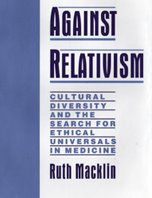
Thus David who is an AIDS-and-human-rights consultant lent me this book. Though not a subject of interest to the general reader I suppose, Ruth Macklin's writing is unusually clear for an academic. Most anthropology and sociology writing is impenetrable, full of jargon and bloat.

Macklin presents a variety of problems facing human rights workers worldwide. Generally they demonstrate the conflict between the wish to provide "universal" human rights to persons within cultures in which those rights conflict with traditional practice. A common argument against the application of a universal human right that conflicts with local tradition is that it is ethical imperialism--that you (ie the Westerner) have no right to impose your values on our culture--there is no "better" or "worse" set of values, only yours, and ours. You do not have the right to criticize the practices of a culture, from outside that culture. Thus do many customs considered abhorrent by the "west" find justification in this "relativist" rationale.

You can go back and forth on this issue. On the one hand it is useful to be reminded that you are after all a product of your own culture and so cannot think much outside the limits of its assumptions. Much as we think we are independent thinkers, we are not "neutral". Mostly we are merely reflections of the common values of the society in which we happen to live. Just like everybody in other societies.

On the other hand if you refrain from criticizing the practices of other cultures because of this relativism, well there goes any notion of universal human rights. They keep slaves in Mauritania, to this day? Well that's their right. Families in China kill baby girls because boys are worth more? Well, who are we to judge!

So Macklin dives in, and tackles issues like female genital mutilation (keeps the women from being promiscuous!) , informed consent or not, for medical decisions, the definition of death, organ transplantation, the reproductive rights of women, and the rights of individual women vs the rights of their families. Macklin describes each case then picks her way through it, to arrive at a well-argued conclusion.

Now I have an idea what a "bioethicist" does. Since reading the book I have mentioned a couple of the dilemmas described, and am surprised to see how quickly people propose an answer to the thorniest of problems.

For example, anthropologists are trained to observe the culture they study, but not to interfere, so as to avoid potential damage to the culture and to their own research. Feminists have an obligation to help other women. What should a anthropologist who considers herself a feminist do when confronted with a situation in which a woman is being abused, and asks for help?

What can be considered "abuse" from outside the culture is considered normal behavior (eg, wife-beating is common Kenya), inside the culture. Is abuse a universal concept, or relative to the culture in which it occurs?

Asian regimes charge that western notions of human rights have no place in their countries because of the notion of "Asian values", in which the common good supposedly transcends individual rights. But Macklin says "...we should not fall prey to the threat posed by "Asian values" to the universality of human rights because the arguments in favor of that perspective are flawed and self-serving tools of leaders seeking to maintain their power by preserving the status quo."

A western-trained doctor who has an obligation to explain the risks of surgery so that a patient may make informed consent, confronts a Navajo who will simply reject the surgery if he hears about the risk, due to the Navajo cultural prohibition against talking about things "in a negative way". What should the doctor do?

A Laotian woman brings her baby to a western doctor, who notices burns on the baby's abdomen. It turns out the mother has burned the baby in an effort to cure a folk disease, by passing a burning reed dipped in hot fat over the skin. If the skin blisters then the baby will recover. If not the baby needs to be seen by a shaman who must perform a spiritual ceremony. In this case the burns numbered five, but as many as eleven burns may be needed. Is the mother abusing the baby? She means well. Who are we to judge?

The book is full of such puzzles.

Monday, February 13, 2006

winter diving

Diving on New Year's Day with the "Dive Society", at White's Beach in Manchester-by-the-Sea near Gloucestor.

Water temp was 41F, air a relatively balmy 27F. Four of the eight of us wore wetsuits, four dry. Wetsuit is okay for one dive--you may be cold when you're done but so what, you're done anyway. That is me 2nd from left.

They go out every Sunday starting January, in winter. I went again on Jan 8, but not since then. Wearing wet gloves I was fine on Jan 1, but hands were very cold on Jan 8. Don't know why. I do have "dry gloves" which attach to the dry suit and are warm. Next time. Fussing with all the gear in the cold before and after, and cleaning the gear at home later, is a lot of overhead for a small amount of fun. After the Jan 1 dive we had a cookout on the beach, and had a big gas burner to stand around while drinking beer and coffee, and eating hot dogs and cake--it was Don the dive leader's birthday. That was fun.

Visibility was for shit but that doesn't matter much because there isn't much to see in winter anyway. The fish are in Boca Raton playing canasta and the lobsters are out deeper. The dive leaders are always upbeat and emerge saying things like, "Have you ever seen so many flanged nudibranches!"

Lots of people get scuba certified locally but only dive in the Caribbean, because the viz there is fantastic, the variety of sealife is amazing, the diving itself is easy. The water is warm and clear so you don't need bulky suits to stay warm, or much weight to get you to sink.

Local divers joke that Caribbean diving doesn't build character. If being scared out of your fucking mind counts then I must have developed plenty of character because I have experienced panic twice and near-panic once by now. I suppose there is something to it. In Bonaire last year though diving four times a day, the word "insipid" crept in. Too much beauty, too much fabulousness? Do I prefer being cold and frightened?

I like diving locally because once you've made the initial investment of $23 million, it's cheap. Unless you go on a boat. I don't care if the viz is more than 10' because usually I'm close to the bottom looking at stuff nearby anyway. I can't bring myself to give a shit about nudibranches, and have no interest in photography which is a specialty the shops push as a means of selling you more gear. Everybody takes the same pictures below so I can just get copies.

I do it mostly because I like the sensation of floating in the silence, listening to my own breathing, and trying to maintain neutral buoyancy. Just being a neutral breathing unit, only kicking enough to move along, feels like a step back along the chain of evolution, to a more contented state of being, mindless yet still aware.

Saturday, February 11, 2006

wakey wakey

Insomnia's diurnal twin is narcolepsy. Whatever sleep I lose at night, there's a corresponding time during the day when my body expresses a strong wish to make up the deficit, and I can konk out in a matter of seconds. Once I nearly fell asleep on my motorcycle on Rte 128, driving home from work in the evening rush hour. I've since sold the bike. I have gotten sleepy scuba diving too.

Falling asleep during the day is distinctly different from nighttime sleep. The sleepiness manifests as a feeling of luscious warmth in the area between the shoulder blades and up the back of the neck, as if the upper spine had turned into warm syrup. It's a luxurious irresistable sensation and the surrendering to it is delicious, unlike any I experience in bed while trying to officially sleep for the night.

Insomnia is an eye-of-the-camel problem. You can only overcome it by not thinking about it. At night while insomniated I read books so boring that they can send me to sleep in less than a minute if I look at them during the day. Insomnia vs boring reading material is a clash of the consciousness titans. Dostoyevsky, Enterprise JavaBeans--no topic is boring enough to defeat insomnia.

Thursday, February 09, 2006

mind control--I wish!

Daniel Dennett from Tufts has a new book, Breaking the Spell: Religion as a Natural Phenomenon. He's making the book tour rounds and appeared on WBUR's On Point interviewed by Tom Ashbrook, and on meaningoflife.tv interviewed by Robert Wright. Ashbrook the "interrupting chicken" was completely unable to slow himself down long enough to get any depth out of Dennett. Ashbrook is so jacked up by his time constraints he keeps one eye on the clock no matter what the subject, yet still manages to yammer on:

"Our time here is short! Daniel Dennett take us on a tour if you will, of your sense of what it means to be Dennett in the here and now. Give us the gist, the flavor, the back and forth, the trip into the provocative new journey of ideas that is Breaking the Spell. Very briefly please! Right after this break!"
Wright on the other hand can take his time and actually knows something, so does better. In Wright's interview, in the topic of consciousness, from about minute 2 to 4, Wright and Dennett really get somewhere.

Dennett says that consciousness is merely "fame in the brain"--an ongoing political battle among "contentful events" vying for control. The event that wins at any given moment is what you are conscious of and that, simply, is what consciousness is. It's not that the winning contentful event in turn kindles some further thing that is consciousness.

This deromanticizes consciousness, which is fine by me. And it matches my prosaic perception of my own consciousness. And therefore must be right! No, I do not claim that because I feel or think a certain way, that it is therefore the case. I do not believe I can influence my health by thinking positive thoughts. I think my thoughts do not matter and that they affect nothing. I think nearly all of my thoughts are trite and fleeting, and are only the result of excess processing power of the frontal lobes. I am Homer Simpson, distracted by butterflies.

Sometimes I walk through Lynn Woods alone, along various routes which take a little more than an hour. Recently along one route I found my mind cranking through one "contentful event" of recent years. Events in the past are stored in the brain as narratives burned into the synapses. Once begun memories of the event invoke the same predictable tedious rationalizations and emotional reactions, in the same predictable sequence. Then after a few minutes, it was on to the next contentful event. Which seemed familiar in turn, at a particular fork in the road.

To my dismay, I realized that not only do contentful events replay themselves with remarkable internal consistency, but that when I go on this walk, they occur at the same point in the walk! At minute 17 of the walk, my thoughts are x1, and so my mood is x2. At minute 26, my thoughts are y1, so my mood is y2. And that whenever we engage in an activity that occupies the body but leaves the mind free to churn, the mind is apt to replay its little collection of anecdotes, in the same sequence, again and again.

Do we have any control over this? Can we direct our own minds, for more than a few moments? Can we "not think" some given contentful event, and think about something else instead, by means of the exertion of will? Grrr, I'm not going to... No. You cannot exert conscious control of your own mind for more than brief moments. It runs on autopilot, not under the control of "you". Off it goes at first chance, either to its habitual list if unoccupied, or to the unselfconscious task of solving whatever procedural chore is at hand otherwise.

Recently I met a guy who had been laid off, who said, "I can be sad about what has happened, or I can think of it as an opportunity to explore new ideas." I thought, that's bullshit. You can't choose how you think or feel about things. You do not have that level of control, because there is no place for "you" to stand outside your thoughts and emotions, to exert control over them, because consciousness isn't a separate place beyond them.

What you can do is practice self-delusion. In which if successful is to be found solace. And you can practice vigilance in keeping stray bits of the stream of consciousness from getting through, by using interference--headphones, radio, chitchat about the weather, even meditation. Or keep it occupied with mundane tasks. Anything to avoid hearing your banal little mind recite its paltry repertoire yet again.

No wonder people are so willing to allow some other agent to drive--the imam, the guru, the vodka.

Meat engines, that's us. Smart lemmings, proceeding zombie-like through the days, reacting predictably to the same stimuli, our minds churning endlessly through the trivial detritus of our puny lives, all the while thinking we are so grand and unique with our deep minds and eternal souls. What greater proof of the existence of god do we need, than our own magnificence!

Wednesday, January 11, 2006

I hate those blue bin people

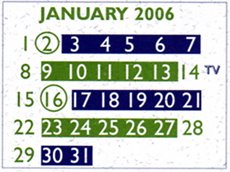
The Lynn DPW sent out a 2006 calendar to show when to put your recycling bin out with the trash. You have a green bin or a blue bin, and alternate weeks. You stick the calendar on your refrigerator so you can see if it's your week or not on trash morning, so you don't put out a bin that they won't collect.

Only problem, green is blue, and blue is green. Are the colors transposed, and green bins go out on days marked blue? Or is the text transposed, and the days marked in the right color on the calendar?


On January 9, blue bins and green bins were out all over the city. Green bin people guessed that the text was transposed and that the calendar colors were correct. Blue bin people guessed that the colors were transposed and the text was correct.

On that same day we received a corrected version in the mail. Too late for that day though. You might think for a publication whose only purpose is to distinguish green from blue, that they would get it right the first time. But it's so easy to carp, to be a critic!

It turns out that the text was correct and the colors on the entire flyer were transposed. Green bins go out on green weeks, and the blue weeks were now the green weeks.

So January 9 turned out to be a blue day, not a green day, and the green bins left out were uncollected.

I have a green bin. I hate those blue bin people. They're so smug. They think they're better than we are. And I hate the ones who guessed correctly most of all. Elite holier-than-thou types. Snobs.

One day they'll get their comeuppance. Comeuppance!