Tuesday, March 28, 2006

linkages

From Richard Dawkins, Postmodernism Disrobed:

Suppose you are an intellectual impostor with nothing to say, but with strong ambitions to succeed in academic life. What kind of literary style would you cultivate? Not a lucid one, surely, for clarity would expose your lack of content.

Well that is rather harsh. Certain jobs such as White House spokesperson or manager require you to appear to be communicating even when that is exactly what you do not want to actually do. Jargon's purpose is to fill otherwise empty air with an illusion of meaning. Mysterious acronyms are added for extra obfuscation. Average listeners will assume that everyone in the room but them understands and that it is only their own ignorance of the topic that prevents their understanding. Perhaps they missed or dozed through the meeting in which the acronym was explained. Few are bold enough to risk exposure to interrupt a bath in the warm goo of this verbal pudding to ask "excuse me, what is KPF mode?" Keep the Plane Flying, of course. Everyone knows that. Haven't you been paying attention?

Such terms are needed to hide unpleasantness. "G-Dick" sounds less depressing than "your job just went to India". "Leverage" sounds better than "take advantage of" or simply "use", so "leverage the infrastructure" sounds like you're doing something clever when in fact it only means that you are using what's already there.

Abstractions achieve the status of concrete nouns over time. "Efficiency", abstract enough to begin with, has become a noun measurable enough to be countable so can become "efficiencies". Which you can then attach an "action verb" to, to sound dynamic, thus "drive efficiencies". A "linkage" can be "linkages", as concrete as sausage links. "Synergy" is likewise an abstraction you can treat as a concrete noun, and "leverage". This language shares with poetry a purpose other than plain communication. Its purpose lies beneath the words--to evoke anti-meaning, to sooth, to mesmerize. A manager has the soul of a poet. Here we explain why your job just went to India:

While eating our own dog food
I will open my kimono to display
the linkages
to the plane that we keep flying
that keeps the boat afloat
that leverages the synergies of the infrastructure,
and drives efficiencies into the regions.

Friday, March 24, 2006

farewell, my lovely clam

I discovered today that my favorite clam shop, Bob's on Highland Ave in Salem, has gone out of business.

Fried clams are in my blood. As a kid we lived next to the "Famous" Clam Plate at the south end of Brown's Pond in Peabody. It had a big sign with a blinking arrow pointing to the restaurant, wrapped around a smiling woman holding a big plate of yummy clams.

"Famous" seems to mean "owned by Greeks", in Greek because every dinky little sub and pizza shop in the area labels itself "famous", and they're all owned by Greeks. It could also mean "not famous."

Many Fridays my mother would just send me over there for a clam plate so she didn't have to deal with cooking fish. I got a take out and ran home and ate it by myself on a little tray in front of the TV. Clams, french fries, coleslaw, tartar sauce, ketchup. Heaven! In those days clams were cheap. Sometimes I'd get a seafood plate for the scallops too.

Somebody set fire to the Clam Plate in about 1966, then set fire to it again the next year. They said the owner had gambling debts. I live in the same neighborhood now and pine for that joint.

Later when we lived in Nahant I got my clams from The Tides. Clams were still cheap. I used to get a large box and eat the whole damn thing sitting on the rocks on the beach, behind the restaurant. The Tides went out of business and changed hands about five times. Now it's owned by some out-of-town company, and they couldn't be bothered with local food--it's all frozen. You can get tilapia and Chilean sea bass there, but not a fried clam from Ipswich.

When I lived overseas after several years away the only things I missed about home were clams and the Bruins. My sister who has moved to New Mexico is similarly afflicted with the yearning for clams. When she visits she makes the trek to Woodman's whose clams are good of course but it's too far to drive. I don't like that you have to go out of your way for clams. Our mother found Bob's. It's across the road from Wal-Mart and next to a storage place. It was completely lacking in character--the lighting was harsh, the decor yellow formica and brown panelling. Most of the clientele were elderly from the senior ghetto across the street. Unlike Woodman's no one travelled more than ten minutes to go to Bob's. But its clams were as good as Woodman's any day.

Twenty years ago at Digital I had a computer named "exclam". Computer names were limited to six characters. Its motto was "Once a clam but no longer--Ex-clam!".

Now, till I find another clam joint nearby, that's me. A man without a clam. An ex-clam.

Friday, March 10, 2006

noun string contest

A noun string is too many nouns strung together as adjectives. They are a classic example of bad writing, because you can't keep track of what modifies what, so can easily lose your way in the sentence. Sun and Open Source documents are littered with these. Here's the reigning champ:

the Sun Java System Application Server Platform Edition 8 runtime deployment descriptor

The tech writers at Sun must toil under the heavy shadow of some lawyer-inflated style guide, and readability be damned. They're so afraid somebody will hijack the word "Java" that they say "Sun Java" every time. Yea we get it, you invented Java. And what about "Platform"--what is that? Isn't it enough to just say server? Isn't a server a platform that applications run on? And "System" is pointless--it adds no value. So all of this:

the Sun Java System Application Server Platform Edition 8

...is just a long way of saying:

the Java Application Server

As for the edition, is there an Edition 7? An Edition 9? Do you really need a different runtime deployment descriptor for each edition? Isn't it just version info--you only need it under the "About" in the help menu, you shouldn't put it in the name of the thing.

But if indeed the version is somehow critical, how about an acronym? The Sun JAS8! Guess not--lawyers are fainting, left and right. If an acronym is too racy, then here is an improvement that jettisons the version number, the pointless "system", and the redundant "platform", for the sake of readability. It's still too long, but breaks up the noun strings with a helping preposition at least:

the runtime deployment descriptor for the Java Application Server

Too simple?

------------------------------------------------------------------------------
Runner up:

this Sears MasterCard Choice Rewards Certificate coupon...

Not a mere certificate or coupon, but a Certificate coupon!

Monday, February 27, 2006

where Mad magazine led me


As for so many of us who did not encounter them in our native habitat, my first exposure to Jews was in the early '60s through Mad magazine. All these nutty, fun-to-say words--ferbissiner, schlep, schmuck, chutzpah--where did they come from? They were Yiddish. The Mad magazine people, the "usual gang of idiots", were Jews, from New York. They were funny in a new way--subversive, outrageous, ridiculous. Poking fun at everything, including themselves.

What a relief to discover that there were other wisenheimers out there. I was not alone. The Three Stooges, another seminal influence on my early worldview were Jewish too, but I didn't realize that till years later.

At St. Newt's Prep we learned more about the Jews including actually meeting some, and watching movies like Night and Fog, about the Holocaust.

I went to Europe in 1975. In Berlin I worked for a month as a volunteer at the Sankt Gertrauden Krankenhaus in Wilmersdorf, a giant state-run nursing home. Many of the patients had been soldiers in WWII--real Nazis. Our job was to feed them, give them their schnapps and their pills, and just provide a bit of humanity. My Mad magazine Yiddish didn't get far but a few knew some English or French. Our primary task was to give them baths. Many were missing arms or more commonly legs. A few didn't want to be given a bath but it had to be done so some wrestling was involved. They were tough codgers and some were pretty big. I picked up a little German to add to my Mad Yiddish.

I spent December in Egypt, visiting friends I had met working in Holland. Then I flew from Cairo to Amman and spent a week in Jordan. I crossed the Allenby bridge and went into Israel where I spent ninety days. I worked for most of that time in Eilat, first for Israelis at the power station, then after being fired, for two Arab brothers who used day laborers to help provision ships docked or anchored at the port. The Israelis were by and large arrogant, abrupt, quarrelsome. They ridiculed and harassed the local Bedouin and had no interest in we few westerners whom they termed "beatnikim", and regarded as dabblers in adventure whereas they were true macho guys and lived the real thing. I took solace in the notion that for all their bluster their country would collapse in a month without massive subsidy from my country. The Arab brothers on the other hand though rough were honest and funny and I got along well with them.

Returning to Jordan over the same bridge on Easter Sunday of '76 I met Peter Jennings in the bus and talked to him. He was returning from a report from the West Bank and was with a blonde woman and a cameraman. Debonair! He spoke Arabic to the border guards. I continued my trip passing through Syria and Turkey. I noted again and again the cordiality of every other group of people in the region, in contrast to the rudeness of the Israelis. Old world manners versus frontier society gruffness. I made a distinction between Jews and Israelis, and developed a prejudice against the latter as a result of my experience with them, that took some time to overcome.

Back in Germany in '76 I worked for five months in Bavaria in the kitchen of a US armed forces recreation center on Lake Chiemsee between Munich and Salzburg. It had been used by the German army in WWII. The baker had worked there since the war. He showed us pictures of Nazis standing out back next to the dock, including him. Hitler's "Eagle's Nest" was just down the road in Berchtesgaden.

One day I visited nearby Dachau.

I saved most of my wages and in the fall travelled through Turkey, Iran, Afghanistan, Pakistan and India on the way to Australia. As an American I was popular in Iran. Everybody wanted to be my friend. I had an opportunity to remain there and teach, but declined. Three years later in '79 the revolution came. I was living in Japan and watched the Iranians on TV with their "Death to America" placards and later with American hostages and thought but surely, this cannot be! Didn't you want to be my pal, not so long ago? I realize you must engage in theatre, to say anything the tyrant of the day commands you to say, in order to survive. I understand. But don't expect me to take the sincerity of your outrage seriously, next time.

Over time my anti-Israeli sentiment faded. I appreciated their disinterest in religion, and came to terms with their brusque, unpleasant persona since it is after all a reaction to the docile public demeanor of their European ancestors, which contributed to their demise. The Nazis exploited the old-world manners of the European Jews. Their tendency to be polite and go along, in an effort to fit in to these cultures that barely tolerated them anyway, rather than make a tsimis, led them right into the trains. Thus, never again. Before it was "Don't make trouble!" Now it's "Don't fuck with the Jews". Better to be feared than liked, was the lesson. Fair enough.

And I've come to be wary of superficial friendliness. "Come join me for tea, my very dear friend!" is to be taken as seriously as "You have delivered a grave insult to my religion!" The friendliness and the anger are both ostentatious, theatrical. As if to say look, see how friendly I am! And look, see how angry you have made me! Such talk is designed to obscure the true, underlying motivations. But you can get too suspicious too. Much cordiality is genuine. But when is it genuine, and when is it not? It's hard for the dinky shallow Westerner to tell and you risk offense of course, by guessing wrong.

So maybe you put up with the rude jerks if they make their intentions clear at least. And maybe you put up with the sweet talkers without ever quite relaxing around them. Such prejudices and irritations swirl and simmer and reformulate themselves around the most recent outrage emanating from the region. Who do you trust today? Sift through the layers of history and intrigue again each time. Americans have no natural feeling for these layers that everyone in the Middle East carries in their bones. Bush the typical dumbass New-World simpleton only gets history as far back as cowboy movies. Yer with me or agin me. You're for democracy as defined by me, or you're with the terrorists.

And many in the Middle East who know better choose to ignore the complexity and seek to stir up the rabble for the venal and irreligious goal of remaining in power. To distract the populace from their miserable lot, claim your authority is divinely inspired, and blame an external agent for your shortcomings. The Jews! Though dishonest, it's too convenient a formula to give up. Religion is the opiate of the people, and anti-Semitism is the crack cocaine of prejudices. The addiction to it is completely reliable. Feh.


Saturday, February 25, 2006

official business


Twice last week I received documents via the post, containing, ma foi, official business! Obviously of greater importance than ordinary, unofficial business, I made haste with the letter opener, only to discover that these were alas only missives (one a "public notice", the other a mere "notice" so, presumably not public) from "Suzuki of Lynnway", and Pride Hyundai, also on the Lynnway, urging me to hie myself thither and avail myself of two "three day only" events. The public notice was for a "special market test program". The regular notice was for a once in a lifetime event.


One piece of official business emanated from the "Regional Disbursement Center", whereas the other came from the "Regional Notification Center". Both Centers have a Dept. of Communications, in an Electronic Mail Section. I wonder if they are at risk of consolidation? I'd be worried, it seems like a bit of overlap.

Though from the Electronic Mail Section, the papery feel of the documents indicated to me that these were not "email" in the usual sense. I wonder who handles their electronic mail--the Paper Mail Section?

The information for the Postmaster, if the Postmaster concerns himself with the delivery of presorted bulk mail, is surely helpful. Regulation F010, Section 4.1, remarkably, exists, as does the "official DMM" which is the Domestic Mail Manual. This information provides the Postmaster with the information he needs to conduct the research necessary to direct the letter-carrier, if the document is undeliverable as addressed, to throw it in the trash.

I am especially fond of "Attention Recipient. Deliver directly to addressee". No funny business. Don't put the notice in your pants and caper about. Don't hide it behind your back and ask, which hand! No sir, you must deliver it directly to the addressee.

And as if the recipient and the addressee were two different people! In fact I, as "United States Postal Customer" (Pride Hyundai) and "Resident" (Suzuki of Lynnway), was both the recipient and the addressee! I therefore amused myself at their expense, by passing the documents from one hand directly to the other, and back again! Ha, the joke is on them!

And I think you would agree that threatening the recipient with punishment for obstructing the mail is quite unnecessary and in fact casts a pall over the entire official business. The Electronic Mail Section must not think much of us recipients. Or perhaps it lacks self-confidence and blusters like a bully to cover a fragile ego. Relax I say! I, the recipient, have no intention of obstructing the U.S. Mail. In fact since I, the recipient, have received this document, which perforce I have since I am reading the warning which is addressed to me, I cannot obstruct its delivery to me because it is, at the point I have reached, a metaphysical impossibility.

Oh Electronic Mail Section, free yourself from your suspicion and bitterness! We, the recipients, and the addressees too, await you, arms wide, ready to embrace, to forgive, to love.


Thursday, February 16, 2006

Who are we to judge?


Visiting David and Ahmed in Montreal in January, the issue came up of a rather disturbing quasi medical/religious practice, metzitzah b'peh, done commonly in New York as part of the tradition of some nutty religion. Ah but who am I to say--what right do I have to judge! (Check for yourself.)

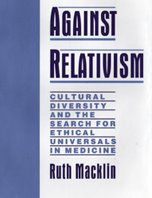
Thus David who is an AIDS-and-human-rights consultant lent me this book. Though not a subject of interest to the general reader I suppose, Ruth Macklin's writing is unusually clear for an academic. Most anthropology and sociology writing is impenetrable, full of jargon and bloat.

Macklin presents a variety of problems facing human rights workers worldwide. Generally they demonstrate the conflict between the wish to provide "universal" human rights to persons within cultures in which those rights conflict with traditional practice. A common argument against the application of a universal human right that conflicts with local tradition is that it is ethical imperialism--that you (ie the Westerner) have no right to impose your values on our culture--there is no "better" or "worse" set of values, only yours, and ours. You do not have the right to criticize the practices of a culture, from outside that culture. Thus do many customs considered abhorrent by the "west" find justification in this "relativist" rationale.

You can go back and forth on this issue. On the one hand it is useful to be reminded that you are after all a product of your own culture and so cannot think much outside the limits of its assumptions. Much as we think we are independent thinkers, we are not "neutral". Mostly we are merely reflections of the common values of the society in which we happen to live. Just like everybody in other societies.

On the other hand if you refrain from criticizing the practices of other cultures because of this relativism, well there goes any notion of universal human rights. They keep slaves in Mauritania, to this day? Well that's their right. Families in China kill baby girls because boys are worth more? Well, who are we to judge!

So Macklin dives in, and tackles issues like female genital mutilation (keeps the women from being promiscuous!) , informed consent or not, for medical decisions, the definition of death, organ transplantation, the reproductive rights of women, and the rights of individual women vs the rights of their families. Macklin describes each case then picks her way through it, to arrive at a well-argued conclusion.

Now I have an idea what a "bioethicist" does. Since reading the book I have mentioned a couple of the dilemmas described, and am surprised to see how quickly people propose an answer to the thorniest of problems.

For example, anthropologists are trained to observe the culture they study, but not to interfere, so as to avoid potential damage to the culture and to their own research. Feminists have an obligation to help other women. What should a anthropologist who considers herself a feminist do when confronted with a situation in which a woman is being abused, and asks for help?

What can be considered "abuse" from outside the culture is considered normal behavior (eg, wife-beating is common Kenya), inside the culture. Is abuse a universal concept, or relative to the culture in which it occurs?

Asian regimes charge that western notions of human rights have no place in their countries because of the notion of "Asian values", in which the common good supposedly transcends individual rights. But Macklin says "...we should not fall prey to the threat posed by "Asian values" to the universality of human rights because the arguments in favor of that perspective are flawed and self-serving tools of leaders seeking to maintain their power by preserving the status quo."

A western-trained doctor who has an obligation to explain the risks of surgery so that a patient may make informed consent, confronts a Navajo who will simply reject the surgery if he hears about the risk, due to the Navajo cultural prohibition against talking about things "in a negative way". What should the doctor do?

A Laotian woman brings her baby to a western doctor, who notices burns on the baby's abdomen. It turns out the mother has burned the baby in an effort to cure a folk disease, by passing a burning reed dipped in hot fat over the skin. If the skin blisters then the baby will recover. If not the baby needs to be seen by a shaman who must perform a spiritual ceremony. In this case the burns numbered five, but as many as eleven burns may be needed. Is the mother abusing the baby? She means well. Who are we to judge?

The book is full of such puzzles.

Monday, February 13, 2006

winter diving

Diving on New Year's Day with the "Dive Society", at White's Beach in Manchester-by-the-Sea near Gloucestor.

Water temp was 41F, air a relatively balmy 27F. Four of the eight of us wore wetsuits, four dry. Wetsuit is okay for one dive--you may be cold when you're done but so what, you're done anyway. That is me 2nd from left.

They go out every Sunday starting January, in winter. I went again on Jan 8, but not since then. Wearing wet gloves I was fine on Jan 1, but hands were very cold on Jan 8. Don't know why. I do have "dry gloves" which attach to the dry suit and are warm. Next time. Fussing with all the gear in the cold before and after, and cleaning the gear at home later, is a lot of overhead for a small amount of fun. After the Jan 1 dive we had a cookout on the beach, and had a big gas burner to stand around while drinking beer and coffee, and eating hot dogs and cake--it was Don the dive leader's birthday. That was fun.

Visibility was for shit but that doesn't matter much because there isn't much to see in winter anyway. The fish are in Boca Raton playing canasta and the lobsters are out deeper. The dive leaders are always upbeat and emerge saying things like, "Have you ever seen so many flanged nudibranches!"

Lots of people get scuba certified locally but only dive in the Caribbean, because the viz there is fantastic, the variety of sealife is amazing, the diving itself is easy. The water is warm and clear so you don't need bulky suits to stay warm, or much weight to get you to sink.

Local divers joke that Caribbean diving doesn't build character. If being scared out of your fucking mind counts then I must have developed plenty of character because I have experienced panic twice and near-panic once by now. I suppose there is something to it. In Bonaire last year though diving four times a day, the word "insipid" crept in. Too much beauty, too much fabulousness? Do I prefer being cold and frightened?

I like diving locally because once you've made the initial investment of $23 million, it's cheap. Unless you go on a boat. I don't care if the viz is more than 10' because usually I'm close to the bottom looking at stuff nearby anyway. I can't bring myself to give a shit about nudibranches, and have no interest in photography which is a specialty the shops push as a means of selling you more gear. Everybody takes the same pictures below so I can just get copies.

I do it mostly because I like the sensation of floating in the silence, listening to my own breathing, and trying to maintain neutral buoyancy. Just being a neutral breathing unit, only kicking enough to move along, feels like a step back along the chain of evolution, to a more contented state of being, mindless yet still aware.

Saturday, February 11, 2006

wakey wakey

Insomnia's diurnal twin is narcolepsy. Whatever sleep I lose at night, there's a corresponding time during the day when my body expresses a strong wish to make up the deficit, and I can konk out in a matter of seconds. Once I nearly fell asleep on my motorcycle on Rte 128, driving home from work in the evening rush hour. I've since sold the bike. I have gotten sleepy scuba diving too.

Falling asleep during the day is distinctly different from nighttime sleep. The sleepiness manifests as a feeling of luscious warmth in the area between the shoulder blades and up the back of the neck, as if the upper spine had turned into warm syrup. It's a luxurious irresistable sensation and the surrendering to it is delicious, unlike any I experience in bed while trying to officially sleep for the night.

Insomnia is an eye-of-the-camel problem. You can only overcome it by not thinking about it. At night while insomniated I read books so boring that they can send me to sleep in less than a minute if I look at them during the day. Insomnia vs boring reading material is a clash of the consciousness titans. Dostoyevsky, Enterprise JavaBeans--no topic is boring enough to defeat insomnia.

Thursday, February 09, 2006

mind control--I wish!

Daniel Dennett from Tufts has a new book, Breaking the Spell: Religion as a Natural Phenomenon. He's making the book tour rounds and appeared on WBUR's On Point interviewed by Tom Ashbrook, and on meaningoflife.tv interviewed by Robert Wright. Ashbrook the "interrupting chicken" was completely unable to slow himself down long enough to get any depth out of Dennett. Ashbrook is so jacked up by his time constraints he keeps one eye on the clock no matter what the subject, yet still manages to yammer on:

"Our time here is short! Daniel Dennett take us on a tour if you will, of your sense of what it means to be Dennett in the here and now. Give us the gist, the flavor, the back and forth, the trip into the provocative new journey of ideas that is Breaking the Spell. Very briefly please! Right after this break!"
Wright on the other hand can take his time and actually knows something, so does better. In Wright's interview, in the topic of consciousness, from about minute 2 to 4, Wright and Dennett really get somewhere.

Dennett says that consciousness is merely "fame in the brain"--an ongoing political battle among "contentful events" vying for control. The event that wins at any given moment is what you are conscious of and that, simply, is what consciousness is. It's not that the winning contentful event in turn kindles some further thing that is consciousness.

This deromanticizes consciousness, which is fine by me. And it matches my prosaic perception of my own consciousness. And therefore must be right! No, I do not claim that because I feel or think a certain way, that it is therefore the case. I do not believe I can influence my health by thinking positive thoughts. I think my thoughts do not matter and that they affect nothing. I think nearly all of my thoughts are trite and fleeting, and are only the result of excess processing power of the frontal lobes. I am Homer Simpson, distracted by butterflies.

Sometimes I walk through Lynn Woods alone, along various routes which take a little more than an hour. Recently along one route I found my mind cranking through one "contentful event" of recent years. Events in the past are stored in the brain as narratives burned into the synapses. Once begun memories of the event invoke the same predictable tedious rationalizations and emotional reactions, in the same predictable sequence. Then after a few minutes, it was on to the next contentful event. Which seemed familiar in turn, at a particular fork in the road.

To my dismay, I realized that not only do contentful events replay themselves with remarkable internal consistency, but that when I go on this walk, they occur at the same point in the walk! At minute 17 of the walk, my thoughts are x1, and so my mood is x2. At minute 26, my thoughts are y1, so my mood is y2. And that whenever we engage in an activity that occupies the body but leaves the mind free to churn, the mind is apt to replay its little collection of anecdotes, in the same sequence, again and again.

Do we have any control over this? Can we direct our own minds, for more than a few moments? Can we "not think" some given contentful event, and think about something else instead, by means of the exertion of will? Grrr, I'm not going to... No. You cannot exert conscious control of your own mind for more than brief moments. It runs on autopilot, not under the control of "you". Off it goes at first chance, either to its habitual list if unoccupied, or to the unselfconscious task of solving whatever procedural chore is at hand otherwise.

Recently I met a guy who had been laid off, who said, "I can be sad about what has happened, or I can think of it as an opportunity to explore new ideas." I thought, that's bullshit. You can't choose how you think or feel about things. You do not have that level of control, because there is no place for "you" to stand outside your thoughts and emotions, to exert control over them, because consciousness isn't a separate place beyond them.

What you can do is practice self-delusion. In which if successful is to be found solace. And you can practice vigilance in keeping stray bits of the stream of consciousness from getting through, by using interference--headphones, radio, chitchat about the weather, even meditation. Or keep it occupied with mundane tasks. Anything to avoid hearing your banal little mind recite its paltry repertoire yet again.

No wonder people are so willing to allow some other agent to drive--the imam, the guru, the vodka.

Meat engines, that's us. Smart lemmings, proceeding zombie-like through the days, reacting predictably to the same stimuli, our minds churning endlessly through the trivial detritus of our puny lives, all the while thinking we are so grand and unique with our deep minds and eternal souls. What greater proof of the existence of god do we need, than our own magnificence!

Wednesday, January 11, 2006

I hate those blue bin people

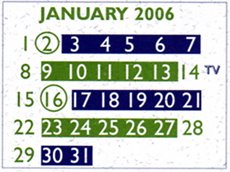
The Lynn DPW sent out a 2006 calendar to show when to put your recycling bin out with the trash. You have a green bin or a blue bin, and alternate weeks. You stick the calendar on your refrigerator so you can see if it's your week or not on trash morning, so you don't put out a bin that they won't collect.

Only problem, green is blue, and blue is green. Are the colors transposed, and green bins go out on days marked blue? Or is the text transposed, and the days marked in the right color on the calendar?


On January 9, blue bins and green bins were out all over the city. Green bin people guessed that the text was transposed and that the calendar colors were correct. Blue bin people guessed that the colors were transposed and the text was correct.

On that same day we received a corrected version in the mail. Too late for that day though. You might think for a publication whose only purpose is to distinguish green from blue, that they would get it right the first time. But it's so easy to carp, to be a critic!

It turns out that the text was correct and the colors on the entire flyer were transposed. Green bins go out on green weeks, and the blue weeks were now the green weeks.

So January 9 turned out to be a blue day, not a green day, and the green bins left out were uncollected.

I have a green bin. I hate those blue bin people. They're so smug. They think they're better than we are. And I hate the ones who guessed correctly most of all. Elite holier-than-thou types. Snobs.

One day they'll get their comeuppance. Comeuppance!

Monday, December 26, 2005

memoirs of inauthenticity

Before seeing Memoirs of a Geisha I thought my objection would be the de-Japanification of that exactly most specifically Japanese of all topics--geisha, for the sake of commercial viability. I was wrong, that is only one of my objections.


The movie plods oh how it plods. The Chinese actresses who play the three main characters do their best but have been cast only with an eye to box-office appeal. They are all better draws even in Japan than any Japanese actress. Though fabulous, especially Gong Li as "Hatsumomo", they don't look Japanese, or convey geisha or Japanese-ness. They can't. It's not simply a matter of acting. Is this a quibble?

There is the language problem. Dubbing and subtitles are box-office poison of course but this alternative, in which everyone speaks English in a slightly British, over-deliberate halting manner, abstracts the characters right out of their setting. Japan without the Japanese language misses most of the point of the place.

The conceit is that you are equipped with a universal translator, or that it's just a really good dubbing job. This conceit breaks down if you introduce actual English speakers into the movie which they do. When the Yanks arrive Sayuri speaks English to one of them (hey, it's Stottlemyer from Monk!) without missing a beat. Huh? Michelle Yeoh speaks beautiful real English to Ziyi Zhang who is obviously just speaking English phonetically.

I used to watch Sumo on NHK TV. You could hear the commentary in Japanese or in English. Even though I couldn't follow all of the Japanese commentary, I couldn't bear to listen to the American announcers. It was excruciating, because a Japanese art, minus its native language, becomes a travesty. The language is woven into the art.

People wonder why Americans can't tell the difference among Asians. We often just use the term "Chinese". But Asians here will mix it up if there's a buck to be had in the blurring of the lines. Chinese restaurants serve cheap sushi and sake at their luncheon buffets. Few of the knife-twirling cooks at Bisuteki are Japanese, but they pretend they are. We are none the wiser. Who cares, a bit of non-threatening faux-exoticism is enough for us. Beyond that and whoa, easy on the details, Poindexter-san!

This would all matter less if the story itself were not so leaden. Eight-year-old Chiyo falls in love with the "Chairman" after a five-minute exchange? How old is a Chairman? It is absurd. Fifteen or whatever years later, after surviving the war, she is now in her mid-twenties, so he is now what, sixty? Chiyo has grown into the adult Sayuri, while Ken Watanabe looks as if he has aged about a month. An apparent 30-year age difference is reduced to a more palatable say, fifteen-year difference at the end, but if you do the arithmetic, the result is preposterous not to mention creepy. Will she be happy for long, spoon-feeding him his tofu in his dotage?

Hatsumomo and Sayuri get into a fight and start a fire in the okiya. Hatsumomo further lights the joint up by spilling oil lamps, and...nothing? The whole neighborhood would have burned down. What happened?

The deprivations of war changed everything, forever, says the narrator. World War II is a picturesque distraction consisting of a couple of trucks rolling through "Gion" or Thousand Oaks, CA, and a shot of planes overhead. These years pass in a minute. Then we see Michelle Yeoh again, expecting her to have aged terribly. But she too seems to be little the worse for wear, having also aged about a month. Her deprivation seems to consist of changing to a modest gray kimono and leaving her hair untended for a day or so.

Bah! Too bad. Compare this turgid plod to Kar Wai Wong's hallucinogenic 2046 also starring Gong Li and Ziyi Zhang, and the House of Flying Daggers, to see what Zhang is capable of. And of course, Crouching Tiger, Hidden Dragon to see Zhang and Yeoh fly.

My favorite Asia-through-the-eyes-of-clueless-Americans movie is Green Berets made in 1968. Starring John Wayne, and featuring such local talent as Jack Soo (Det. Yemana from Barney Miller), and George (Mr. Sulu) Takei playing South Vietnamese Army officers. Wayne, Aldo Ray and a crew of paunchy, freshly shaved and scrubbed middle-aged farts lumbering around Georgia among the arid pine forests playing soldier in the jungle. The pine jungle. It looks about as much like Southeast Asia as Norway.

Thursday, December 22, 2005

before you begin--oops, too late!

This summary is not available. Please click here to view the post.

Tuesday, December 20, 2005

bartleby otsuka pynchon RAQ

Bartleby the Scrivener is a short novel by Herman Melville written in 1853, about an office clerk famously known for his refusal to do work by repeating the phrase, "I would prefer not to." Blog commenter Bartleby has twice now expressed curiosity about how certain entries in this blog relate to certain lyrics found in Japanese pop music.

The first comment to "Brother Linus channels the SubGenius", posted on 11/01/05:
Interesting. Can you explain the significance of the lyrics "Koi suru onna no ko no Victory" by Morning Musume?

The second comment to "A is not Q's patsy", posted 12/20/05:
But how does this relate to Otsuka Ai when she chimes "waratte waratte kimi to ashita aitai" ? Could it be related to the crying of lot 49?

I will address the second comment first due to a mood of LIFO-ness.

The line is the chorus from Otsuka's single "Smily", which has sold more than 300,000 copies:
"smile smile, I want to see you tomorrow"

Otsuka Ai or Ai Otsuka when she's filling out her US visa app, is a highly-popular, 23-year-old typical 95-lb super-cute ("kawaii") J pop singer. "Kawaii-sugi" (too cute by half) if you are as sick of "kawaii" as I am. But that's the mold. She'll be a beautiful woman someday if she ever grows up. She has that thin nasal voice demanded of the genre, but plays the piano and writes her own lyrics at least. The Smily video is online. There's even a Smily ringtone!

The Crying of Lot 49 is of course the trippy convoluted '60s Thomas Pynchon novel, assigned to me in senior-year English class at St. Newt's Prep. (How did Bartleby know this?) Like most books assigned at school, I never got through it, but remember its later fame for being among other things the source of several references in the '84 movie The Adventures of Buckeroo Banzai Across the 8th Dimension ("no matter where you go, there you are"). Mostly notably perhaps, the Yoyodyne corporation, workplace of the Red Lectroids. The protagonist in Lot 49 was Oedipa Maas, a young woman (like Otsuka--hmm...) who inherits her boyfriend's estate when he dies. Lot 49 was an auction lot containing her boyfriend's stamp collection. "Crying" a lot is what they call the bidding at an auction.

But this is all preliminary. A complete explanation of the relation between Q is not A's Patsy, Otsuka Ai's Smily lyric, and The Crying of Lot 49 will require months of further research. Until that time you may amuse yourself by looking at my old Tokyo home, which I shared with a certain Chris Bartleby among many others, and which could have fit into a Pynchon novel, no problemo.

Sunday, December 18, 2005

A is not Q's patsy

(In which A responds to perceived bullying by Q and rejects one of Q's criticisms of the FAQ.)

A. I don't answer to you, you pompous windbag.
Q. How dare you?

A. Your questions serve only to advance your narrow agenda, not to provide illumination.
Q. You presume to lecture me?

A. Indeed it is in the answer that the knowledge lies, not in the question.
Q. Are you questioning our arrangement?

A. The question is subordinate--merely the path to the answer. The answer is the destination, the goal.
Q. Do you seek to undermine my authority?

A. The phrase "asked question" is not necessarily redundant.
Q. But did I not force you to agree, that unless a question is asked, it cannot exist?

A. A statement is only truly redundant if it is redundant from every possible perspective.
Q. What are you talking about?

A. Though a question must be asked to exist, it is also valid to consider, for example, how often the same question is asked. One question may be asked rarely ("Where are the Crispins of yesteryear?"), while another may be asked frequently ("Where did I leave my goddam keys this time?").
Q. What is your point?

A. Distinguishing between questions that many people ask, and questions that few people ask, and answering the former, is not only an efficient means of conveying information, it is also a non-redundant perspective on the phrase "asked question".
Q. Can you run that by me again?

A. Unless the phrase is redundant from every possible perspective, the phrase is not redundant. I have provided a non-redundant perspective of this phrase, therefore the phrase is not redundant.
Q. Do you think anyone will listen to you?

A. Indeed "asking" a question, is the most common thing people do with questions. In fact, since someone must ask the question for it to come into being, it is not only not redundant, but necessary.
Q. Surely you don't think you can get away with this, do you? How will people pronounce FQA?

A. To ask the question is the most common way to convey it. For example, you ask "Where are my keys?", and you can ask the question "Where are my keys?" (Redundant, or not? you be the judge!), but you cannot just question "Where are my keys?".
Q. What about posing a question? Pondering, bringing up?

A. Yes, and you can "question" authority. But authority is not a question. I need only demonstrate that "asked question" is not redundant from every perspective. My work here is done.
Q. Wait, don't go. I'm not done! Don't you want to hear my next question?

A. In conclusion, unlike your questions about the redundancy of the phrase "asked question", your questions about the hypocrisy of the FAQ writer just making up questions with no idea of their actual frequency, showed promise. Perhaps some day you will ask questions (!) worthy of my answers.
Q. Can we meet again?

Saturday, December 17, 2005

CL smites the defilers

The Catholic League is shocked (shocked!) at the defilement in the South Park episode "Bloody Mary", described in control my life, please.

In a news release, they request of the nearest available Catholic, Joseph Califano who is on the board of directors of the company (Viacom) that owns the company (MTV) that owns Comedy Central, that he intervene to get an apology to Roman Catholics and a pledge that this episode be permanently retired, and not made available on DVD. Failing that they ask that Califano issue his own statement of condemnation.

Take that, Butters! But if the Queen Spider couldn't stop Red Hot Catholic Love from getting on DVD (season six--in stores now!), probably Califano won't be able to stop Bloody Mary, either.

And not a word about the point of the show which was the ease with which we give up our self-determination in favor of relying on whatever hint of a greater power happens along, no matter how ludicrous.

Oh that's right, encouraging the worship of Mary's face in a window stain or a bagel is the business they're in.

Thursday, December 15, 2005

the why FAQs suck FAQ

Q. Isn't the act of asking a question, what makes a question be a question?
A. Yes. It is the asking that brings the question into being.

Q. Can an unasked question exist?
A. No! For it is in the asking, that the question comes to be. Left unasked, it does not exist.

Q. Isn't, then, the phrase "asked question" not only redundant, but downright stupid?
A. Yes.

Q. There would be no point, then, in creating a FUQ, for frequently unasked questions?
A. As a Zen koan, perhaps. And it would be more fun to say than "fack". But though an amusing concept, such a list would be impossible to create due to the metaphysical contradiction alluded to in the earlier questions.

Q. Would not "FQ", meaning "frequent questions", be a better term?
A. The purpose of the A in FAQ is to provide pronounceability of the acronym. "fack", though a hideous word which sounds like you are ejecting a hairball from the throat, is easy to say. "FQ" is too much trouble to say. Redundancy and stupidity is the price we pay for this convenience.

Q. "Frequently asked" implies some mechanism for sending questions to you, the FAQ owner, such that you can tally them up and answer the ones you receive most often. Is there such a mechanism?
A. No. The implication is deceitful.

Q. How then, do you know what questions are frequently asked? Or even asked at all?
A. One question at a time please. The answer to both is the same. I do not know.

Q. Are you just making up what you imagine people might ask, because you have no way of actually knowing what they might ask?
A. Yes it is true. I make the questions up because I have no way of actually knowing.

Q. Are you aware that the practice of providing a FAQ with a new product is inherently dishonest, because a new product has not been available to those who might ask questions about it long enough to count up the questions to determine their frequency?
A. Boy you got me on that one.

Q. How do you live with this hypocrisy?
A. It is a source of unending shame.

Q. In fact is not a developer the worst person to come up with the questions in a FAQ, because that person knows the product too intimately to put themselves in the position of the very person who needs the FAQ the most, a person who has just come to the product knowing nothing, who looks to the FAQ for informational sustenance?
A. I am forced to admit that you are correct.

Q. Is a FAQ just a lazy way of writing your documentation, because it's too much trouble to organize the information logically, by topic?
A. Yes, it is true.

Q. Is the real reason you have a FAQ, in spite of in your heart knowing it is deceitful and lazy, that you think people expect you to have one, because everybody else does?
A. Yes my friend. You have revealed the truth.

Q. Are you aware of the fallacy known as ad populum or "appeal to popularity", which states that because most lemmings approve of a claim (in this case, that a FAQ is necessary or good), that the claim is therefore true?
A. Yes. At one time most lemmings thought the world was flat. But that did not make it so.

Q. Do you resolve then to get out of the FAQ-writing business, and pledge yourself to righting this wrong by being honest with your readers?
A. I so resolve. Henceforth I pledge to write either proper topic-based documents, or provide the less pronounceable but more truthful QIGPMABIFHNFIITW--Questions I Guess People Might Ask But In Fact Have No Fucking Idea If They Will.

Q. When encountering a new object, what do you suppose is the most frequent first question about the object?
A. What is it?

Q. What is GlassFish?
A. I don't know. The question is insufficiently frequent to be addressed by a FAQ.

the GlassFish breathmint floorwax dilemma

After a couple of months I have begun to dip my handsome new toe back into Java. It's a world where words mean anything--how I missed it!

"GlassFish", for example. What is it, exactly? Go to the GlassFish page and figure it out.

First, the page header is "GlassFish Community" but you are in the Projects tab, not the Communities tab. You might think, naive you, that they would explain what it is, not who they are. (A rude secret: I do not give a shit who they are--I only want to know what it is!) They are a community! But it looks like a project--there's a button on the left after all, that says GlassFish Project Home. Maybe it'll say what it is there! Click on it and surprise, it goes back to the page you're already on, the community page! So I guess it's a project, about a community, that is building a server.

Maybe the FAQ will explain what it is. Hmm the first question is not what is it, which would seem to me to be frequent question Number One, but rather, where can I get it. [12/17/05 Since modified! Now they say, What is Project GlassFish? first--still not What is GlassFish, but closer.] No worries, I see on the FAQ, a "New to GlassFish" link. I'm new--I want to know what it is. Follow this link and hmm...this link says it's a project, after all. I can introduce myself to others participating in the GlassFish project, I can become a part of it, I can even request a feature!

The GlassFish project provides a structured process...

So, I know that its community is building a server, and its project is providing a process. I just don't know what it is.

Let me click on the Communities tab at the top, to get my bearings. To see a list. At right is the list of communities but what's this--GlassFish is not listed! Ack where the hell am I? Thank goodness for the Back button.

Of course, I am being coy with you! I know what it is--it's an application server. They re-use the name of the community, and the project, for the actual thing. And not just any server, but an "Open Source Java EE 5 Application server". Which I installed. At least I think I did. When I run the server, the title is:

Sun Java System Application Server Platform Edition 9.0

Uh...did I do it right? Do they have enough goddam nouns in there? Sun is the noun string champion. "Platform Edition"--what's that? Is it like the "Platinum Edition"? Is this in fact "GlassFish"? If so why doesn't it say so? Otherwise why did they bother to call it GlassFish in the first place? Where's the little fish logo? And on the bottom of the Welcome page is a link to Project GlassFish "Sun's open source application server", with no acknowledgement that this is that server! Isn't it?

Oh how I remember now, why I fled screaming from these semantic tanglers. Where Apache is a software foundation, a project, and a web server and it's up to you to figure out which one they're talking about at any given moment. How about "Apache Tomcat"! It's why so many people think Tomcat "runs on" Apache. Why isn't it "Jakarta Tomcat"--it wouldn't be confusing enough?

How can such brilliant people be so lousy at explaining themselves? Why are they so willing to attach the name to the community and the project, and so timid about attaching the name to the only thing that actually matters. Come on then, out with it. It's: the GlassFish Application Server! And put the name in the product! If GlassFish is not its name, then don't call it that in the install, and toss it on the dustheap of useless terms like "Jakarta".

Here is my suggestion. The most important information to convey about a thing is, what is it. Not who are the nice people in the community that builds it, and not that the project provides the nice process that helps you build it. But, WHAT IS IT. Say that first.

Wednesday, December 14, 2005

toe job

Upon deciding to "retire" I quickly contacted an orthopedist in Brookline (reminiscent of J'aurais voulu avoir un marchand d'épingles a cheveux en Belgique--I would like to contact a hairpin salesman in Belgium) to whack off that cause of much pedestrian grief, the excess bone at the base of the right big toe, that looked like a bunion but was not. Known as a "dorsal" bunion because it looks in X-ray like the dorsal fin of a fish, it is not in fact a bunion at all but rather a bone spur, a byproduct of hallux rigidus which is Latin for "stiff toe". Latin can make anything sound impressive.

So it is a faux bunion. Change the first and last letters and you get a Paul Bunion. (Ya I know, he was a Bunyan.)

The deed was done as an outpatient, at a remarkably efficient orthopedic clinic/factory (saws buzzing, knees, feet and elbows flying every which way), on Sept 13, using local anaesthesia. I was able to recuperate on the company nickel with a few days off, followed by a few days of "working" at home.

The picture at left was the unveiling two weeks later.

The surgery fell into a gray area--not cosmetic, but strictly speaking not necessary either. "Elective"--the sort of thing you could live without, if you don't mind wearing sneakers for the rest of your life. How about showing up for that job interview in sneakers! Well Mr Keefe we would have offered you the job but your footwear, I'm afraid, does not meet the high standards we set here at Bratwurst, Longjohnson and Feen... However it is cosmetic in the sense that it does not repair the underlying ailment, which is arthritis of the joint, and of which ze bump is but a mere symptom.

I had had the left one done two years earlier, by a different hairpin salesman. The most famous victim of this ailment is Shaquille O'Neal.

Now a mere 90 days later, I hobble carefree again! Well not quite. The joint still hurts when wearing shoes or standing en pointe in my tutu, but tant pis, more motion is gained, and I was sick of looking at it anyway. And if not then, never. Complete benefit of the surgery takes six months. I got some Percocets out of the deal at least and the urge, for some reason, to toss high-school French about.

Meanwhile other arthritis advances. Gains a toehold. The neck is going a bit stiff when turning to the right, a condition most obvious when backing up the car. Soon I will be one of those old coots who backs up using the rearview mirror instead of turning around to look.

Attention, un vieil imbécile conduit!

Monday, December 12, 2005

control my life, please

In the South Park episode "Bloody Mary", the sensei lectures Stan's karate class about "serf-disciprine". His dad Randy then gets pulled over for drunk driving while giving the kids a ride home. His sentence includes attending AA meetings, where he is forced to engage in the twelve-step program. Step One is to admit that he has no control over his alcoholism, because it is a "disease".

Since he has no control, he confines himself to a wheelchair, continues to drink, and waits for the only possible cure, divine intervention. He is finally "cured" by visiting a statue of Mary that is miraculously shooting blood out of its ass. It is then revealed that the statue is not really miraculous (!) and that therefore Randy must have, albeit unwittingly, cured himself. Stan suggests to his dad that this is perhaps an indication that the cure for overcoming a personal weakness is to be found within oneself, by means of "serf-disciprine".

Funny, I have the same objection to AA. Step One: admit that you have a "disease", so are powerless and must rely on God to cure you.

My brother went to AA meetings for ten years till he drank himself to death at the age of 39. But, AA was and often is the only game in town. What about alternatives? How about Rational Recovery?

My mother went to a few Al-Anon meetings, for the relatives of alcoholics, but she did not gain comfort from listening to more of the travails of families with drunkards. She needed less, not more exposure to the problem--perhaps "Al-Anot"--meetings of people whose relatives were not alcoholics. If such people exist.

The closest I've come was attendance at satsangs or devotional meetings, for the followers of the Guru Maharaj Ji who was quite big in the 70s. Once at UMass on a lark, and again when I lived in Sydney. A neighbor, relatively sane for a cultist, was a devotee who, tired of my ridicule said that I shouldn't poke fun unless I saw for myself, which, after taking steps to assure that I would not be murdered and sacrificed to the guru, I did.

Devotees took turns rambling on with the familiar tale of redemption--how they were lost, helpless on their own (sound familiar?) until they found AA I mean the Maharaj Ji, and how he had changed their lives since.

Later back in the US my housemate's brother moved in with us, and satsanged about the Maharaj Ji over the phone for hours each night, because he couldn't reach the meetings because he didn't have a car because he couldn't afford one because he couldn't hold down a job because he was out of his fucking mind. He was also a rare male anorexic, who ate according to the dictates of Arnold Ehret's Mucusless Diet Healing System, until he died.

Alcohol, Maharaj Ji, Jesus, the Pope, the will of Allah, mucus avoidance...is there no end?

Relinquishing our self-determination to whatever "greater" power happens along during a time of weakness, is humanity's most compelling urge....

Saturday, December 10, 2005

sunk cost

Barry Schwartz, in The Paradox of Choice (which I finished so can cross off my list), talks about "sunk costs". He mentions those expensive shoes you bought that are sitting in the back of the closet. You keep them even though you know you're never going to wear them again, because to get rid of them would force you to acknowledge a loss.

Similarly, people hold on to stocks that have decreased in value because selling them would turn the investment from a potential loss into an actual loss.

What should matter says Schwartz, are the prospects of future performance, but what seems to actually matter is the level of previous investment. He believes that "sunk-cost effects are motivated by the desire to avoid regret rather than just the desire to avoid a loss". "Regret avoidance" is a stronger demotivator than simple "loss avoidance" because taking the corrective action forces you to acknowledge the source of the regret, which is your personal responsibility for an initial decision which has turned out to be flawed.

His final example is Vietnam, and is apropos of the suddenly-legitimate argument, thanks to Jack Murtha, that we should get out of Iraq quickly:


And arguably, why did the United States persist as long as it did in Vietnam, even when it was plain to virtually everyone involved that no good outcome could result from continued involvement? "If we get out now," people said, "then all the thousands of soldiers and civilians who have died will have died in vain." This is thinking in terms of the past, not the future. Those who had died were dead and could not be brought back. The questions that should have been asked (all moral and political considerations about the appropriateness of the war aside) concerned the prospects of soldiers and civilians who were still alive.


Maybe we should leave Iraq soon, or maybe we should remain "as long as it takes". But the reasons to stay should not include that otherwise those who died did so in vain. Or that leaving would force us, or more specifically the President, to acknowledge and therefore take responsibility for, the error of the initial decision.

These are powerful, but not valid, reasons to remain in Iraq. They represent the fallacy of the sunk cost.